


ECC NEWS

Open Hearts, Empty Cages: Kiki!
June 16, 2010
Saving Bubba!
May 30, 2010
You'd be nuts to pass up adopting Acorn!
April 20, 2010
Open Hearts, Empty Cages: Carrol & Isis!
April 18, 2010
Adopt Basketball!
April 13, 2010
Open Hearts, Empty Cages: Mercury The Hen Finds Home Down South
March 22, 2010
Mercury (right) with her good friend Doodle at Chocowinity Chicken Sanctuary in North Carolina
ECC Volunteer Staff Member Kelly with Mercury During a Dust-bathing Session
They Are All Oreo: How Oreo's Law Will Save Shelter Animals--And Help Stop Animal Abuse
March 11, 2010
Thin Valentine is looking for a home. Her and her friends need you to support and promote Oreo's Law.
Julio after returning from his neuter surgery. He went from possible hypothermia victim to possible kill statistic to a great home in about a week. Julio and his feline fellows need you to contact your NYS Assembly member and State Senator to support Oreo's Law.
Willie, AKA Joshua, was pulled from NYC Animal Care & Control\'s Kill List by Empty Cages Collective. At the time, he had a bad cold and needed surgery on his injured eye. He is now in a wonderful home. Many cats and kittens like Willie will have a chance at a life if Oreo's Law passes.
Oreo before being killed. Labor Organizer Mother Jones said it best: Pray for the dead and fight like hell for the living.
Open Hearts, Empty Cages: Biggles Finds Love
February 14, 2010
Open Hearts, Empty Cages: Colette Goes Home
January 30, 2010
Opossums & Skunks Need Advocates, Too
January 24, 2010
Skunks aren't vermin - they're just neighbors.
Opossums are North America\'s only marsupial - and are entitled to be treated like thinking, feeling beings not "pests"
ECC Rescues West Village Roosters!
January 22, 2010
One of the roosters Empty Cages Collective rescued from Laguardia Corner Gardens in the West Village. This young man had a severe respiratory infection that required antibiotics when we received him!
Open Hearts, Empty Cages: Fern Finds A Home For The Holidays
January 15, 2010
Another Brooklyn Group Supports Oreo's Law--Now, It's Your Turn!
January 5, 2010
Basketball was pulled from the kill list at Animal Care & Control by Empty Cages. Should she have died if a shelter director decided he or she didn't want to work with ECC? Oreo's Law would provided needed protection for cats like Basketball.
He's Clinton. He Needs A Home!
January 4, 2010
ECC Helps Ailing Red-tailed Hawk on Christmas
December 31, 2009
The Social & Secret Life of Chickens Lecture: Wednesday, December 30th
December 27, 2009
Thanks St. Saviour!
December 26, 2009
ECC depends on the support of people like you! Without it, we can't continue to rescue animals like Jaimey - who would have been unnecessarily killed without our intervention.
Did your food have a face... and a tool?
December 17, 2009
"Every creature is better alive than dead, men and moose and pine trees, and he who understands it aright will rather preserve its life than destroy it - Henry David Thoreau"
Open Hearts, Empty Cages: Rocco Gets Lucky!
December 12, 2009
Pelfry Wants To Be The King Of Your Castle
December 11, 2009
Special Duffy Needs A Friend...
December 8, 2009
ECC Helps 16 Budgies Fly Away From A Bad Situation
December 7, 2009
IMPORTANT! Help Pass "Oreo's Law"
December 4, 2009
ECC <3 Molly
October 25, 2009
Saving Gidget
October 13, 2009
Gidget gets some fresh air at Coming Home Animal Sanctuary
Marcos Gets A Helping Hand!
October 9, 2009
Marcos gets a helping hand from ECC
ECC Needs Your Help To Rescue & Protect Urban Squirrels
October 8, 2009
Photos courtesy Jesse Bruah
Open Hearts, Empty Cages: Orville's Story
October 8, 2009
Open Hearts, Empty Cages: Eve!
September 15, 2009


Eve & her big brother Kiwi
Help Stop Dunkin' Donuts Abuse of Heifers & Hens
August 2, 2009
ECC Gives Mourning Doves Something to Be Happy About!
July 21, 2009
Our Friend Wesley Needs Your Help!
July 20, 2009
The Underground Railroad for Roosters
May 7, 2009
Togetherness
April 23, 2009
Come on down!
April 8, 2009
Open Hearts, Empty Cages: Peter's Tale
March 26, 2009

Torpedo Turned Peter has turned into a strapping young cat in a happy home.
Peter greets his person at the door almost daily.
Saving Ginny
March 16, 2009

Ginny's mugshot from Animal Care & Control didn't capture her beauty or her tragic story
Ginny's slept deeply on her first night out of animal control
Open Hearts, Empty Cages: Irving's Story
March 14, 2009

Irving: A few days after rescue

Irving and his guardian, Defne

Irving relaxes in his permanent home!
New York State Beavers Suffer Three Weeks Longer. Help Stop It.
March 13, 2009

Beavers are intelligent beings worthy of compassionate and just treatment
Clancy Needs Your Help!
March 11, 2009

Clancy was called Winky when we first rescued him due to his condition!
With veterinary assistance, Clancy could live without chronic discomfort
Fighting For "Fighting" Roosters
March 5, 2009
Pablo makes friends with one of ECC's volunteer photographers
"Injustice anywhere is a threat to justice everywhere." - Martin Luther King, Jr.

"Every creature is better alive than dead, men and moose and pine trees, and he who understands it aright will rather preserve its life than destroy it." - Henry David Thoreau
Saving Rabina
February 19, 2009

Rabina awaiting death or rescue at ACC

Rabina relaxing at the ECC Shelter Space
Being Positive About The Present
February 7, 2009

Eartha maintains a positive mental attitude

Heath grows bigger everyday
Prospect Heights Garden Cats May Become Victims of Intolerance
January 12, 2009

A cat trapped and sterilized by Empty Cages Collective awaits return to her colony
Open Hearts, Empty Cages: Adam's Story
December 19, 2008

Adam just days after he was found on a busy street in Crown Heights

Surveying his new kingdom

Hanging with the boys

Naptime!
Help Make Our Communities Safer - For Everyone
December 13, 2008
Open Hearts, Empty Cages: Quark (nee Zorro's) Story
December 10, 2008
Be Nice To Mice! Ban Glue Pans At Columbia University
November 29, 2008
Give Theresa Something To Be Thankful For!
November 27, 2008
Ocean Needs A Wave Of Luck - Or Just You!
November 25, 2008
Open Hearts, Empty Cages: Juliette
November 23, 2008
ECC Loves Lucy (and Hodgepodge too!)
September 12, 2008
Open Hearts, Empty Cages: Jake Goes Home!
August 27, 2008
Reason 5,999,999 To Get Active In Trap-Neuter-Return
August 23, 2008
Simon Says "Thanks!"
August 19, 2008
Raccoon Rights
August 19, 2008
Saving Little Lives
February 17, 2008
On Monday, February 18th, Empty Cages Collective volunteers rescued 11 white mice - two mothers, a father, and eight babies - from certain death in Sheepshead Bay, Brooklyn. The mice were destined to be dinner (for reptiles) or simply abandoned. Empty Cage Collective volunteers found out about the family in need when a New York City Craigslist Ad offered the little ones to anyone who would take them - for any reason - for free. Our fears for the mice's welfare were well-founded. The mice were being used as food for snakes before their "owner" abandoned the snake. Furthermore, the animals offered in "Free" advertisements on Craigslist have a history of enduring abuse. For example, on September 16th, 2007 a man in San Antonio, Texas tortured, mutilated, and disemboweled three gray tabby cats. All of the cats were obtained from Craigslist postings.
Mice are intelligent, sensitive, and clean animals who often get the short end of the compassion stick. Whether it be due to experimentation, the pet trade, cruel methods of "pest" control, or a general attitude of disregard and distaste, mice suffer immensely and die unnecessarily en masse in this culture. For mice deemed "feeders" for exotic "pets" (who shouldn't be imprisoned in captivity to begin with), life means overcrowding, lack of stimulation in their small cages, lack of veterinary care and an unnatural death. Rodents in the wild have the opportunity to escape their natural predators, whereas "feeder" mice and rats never do. White mice are purposefully bred for docility, making them less prepared for an encounter with a snake, lizard, or other predator. They are the unmentioned victims of the exotic animal pet trade.
Luckily for these mice, their future includes clean spacious surroundings, wheels, toys, nutritious food, companionship with members of their own species, fresh water, and compassion from humans. We are looking for good, permanent homes for them. If you would like to donate to their care or are interested in adoption, please contact us at emptycagescollective@gmail.com or 1 800-880-2684.
If you would like to help other rodents, please get involved to rid do-it-yourself improvement store Lowes of cruel glue traps. From the People for the Ethical Treatment of Animals website:
"Glue traps are among the cruelest pest-control devices on the market today. Animals who get stuck to them suffer for days before they finally die of starvation, dehydration, self-mutilation, and shock. Patches of skin, fur, or feathers are torn from their bodies as they frantically struggle to escape the relentless adhesive.
Many animals resort to chewing off their own limbs in a desperate attempt to free themselves from the traps, and others get their noses, mouths, or beaks stuck in the glue and suffocate. Imagine being stuck in a giant glue trap and having to gnaw off your own leg just to break free.
PETA has presented Lowe's with graphic photos and video footage of small animals, including birds, who suffered painful injuries and died lingering deaths after being ensnared by the cruel traps. But so far, not this, nor the fact that other companies--including CVS, Rite Aid, Albertsons, and Safeway--have banned glue traps because they are so cruel has persuaded Lowe's to do the right thing and get rid of them once and for all."
Please take a moment to write, call AND Fax to the individuals below urging them to stop selling glue traps.
Patti Price, SVP
Robert Niblock, CEO
Lowes
1000 Lowe's Boulevard
Mooresville, NC 28117
1-800-445-6937
704-757-0611 (fax)
June 16, 2010
Categories: Empty Cages
Kiki was one of three tiny kittens rescued from a feral cat colony in Fort Greene. One of our dedicated volunteers feeds the feral and abandoned strays on this block and found the litter by surprise when she was doing her daily feeding and watering of her colonies.
Kiki and her siblings were quickly rescued (and their feral mother trapped, vaccinated, spayed and returned) and brought to Empty Cages Collective. Once they were spayed/neutered and vaccinated, the babies were ready to head home! A wonderful woman named Morgan decided she liked Kiki best! Kiki has adjusted wonderfully to the good life, loves her new big brother Bear and sleeps with her new family every night. Congratulations Kiki!
Saving Bubba!
May 30, 2010
Categories: Rescue
Bubba the little baby pigeon was brought to Manhattan Animal Care & Control by a member of the public. He was scheduled to be killed since none of the other pigeon rehabilitators was calling ACC back--and ACC wanted him out by the end of the day. Luckily for him, ECC rescued him from ACC and is currently caring for him! He will be released back into the "wilds" of Williamsburg, Brooklyn very soon! Please contact ECC if you are willing to be an emergency contact transporter to help with picking up animals from places where they are in trouble or to help with transport to and from our veterinarians. This is an important job that we always need help with! (Photo by Jessica Bruah).
You'd be nuts to pass up adopting Acorn!
April 20, 2010
Categories: Adoptables
Acorn is a nine-month old cutie who was rescued as a sick stray from the streets of Crown Heights. He's feisty and funny, he loves the culinary arts, and he's as healthy as can be... but he's still a little shy around strangers.
Acorn needs a patient guardian and a quiet home to warm up to the good things life has to offer. Can you bring Acorn out of his shell?
Open Hearts, Empty Cages: Carrol & Isis!
April 18, 2010
Categories: Empty Cages
Carrol, aka Miel, was rescued from the mean streets of Greenpoint. She was found under a log sick and terrified, but not wanting to leave her perceived safe space. Carrol was the most recent target of a nearby neighbor who has made it her personal mission to kill the neighborhood's cats by capturing them and sending them to NYC Animal Care & Control to be killed. The odds were against Carrol making it to her next birthday, so Empty Cages Collective (ECC) quickly intervened.
Within a few days with ECC (with love, food and medication) her fear evaporated and she became a loving cat ready to find a home to share with a loving human roommate or two.
Carrol quickly became a favorite at the ECC shelter space, as volunteers loved to pet such a fluffy, adorable kitty. And Carrol enjoyed the space far more than when she was hungry and scared out in Greenpoint, fighting for survival and avoiding run-ins with people that think strays and abandoned kitties should be at Animal Care & Control rather than on the streets. And while ACC might keep cats sheltered from the elements, they are far more at risk of death there, in a kill shelter space. But thankfully Carrol was found and rescued before she would have to suffer that fate.
After a longer than expected stay at the ECC shelter space, Carrol was finally adopted at the end of February. Isis and Jim came to see her and fell in love with her. Her transition to her new home began a bit rough as she spent a bit of time hiding under the bed, overwhelmed by her new quarters. But she adjusted quickly and now follows her human living companions all over the house and talks to them often. In fact, on a recent long trip to the vet Carrol was calm and collected; though, understandably, she was very happy to be home when it was all over.
Isis said that it took about a full month for Carrol to be fully comfortable with her new home, but they can tell she now knows she scored well to have have such a loving home. She enjoys when friends come to visit as she gets to showcase her very sweet curious nature. And when she is not making new fans she has taken to claiming her favorite spot on the couch and in her favorite chair.
Carrol is now in the arms of a stable and loving home. What better place could there be for such a wonderful and loving cat?
Help make it possible for other cats to transition to permanent homes by DONATING to Empty Cages Collective so we can work to assist other cats to find as loving a home as Isis and Jim have given to Carrol.
Within a few days with ECC (with love, food and medication) her fear evaporated and she became a loving cat ready to find a home to share with a loving human roommate or two.
Carrol quickly became a favorite at the ECC shelter space, as volunteers loved to pet such a fluffy, adorable kitty. And Carrol enjoyed the space far more than when she was hungry and scared out in Greenpoint, fighting for survival and avoiding run-ins with people that think strays and abandoned kitties should be at Animal Care & Control rather than on the streets. And while ACC might keep cats sheltered from the elements, they are far more at risk of death there, in a kill shelter space. But thankfully Carrol was found and rescued before she would have to suffer that fate.
After a longer than expected stay at the ECC shelter space, Carrol was finally adopted at the end of February. Isis and Jim came to see her and fell in love with her. Her transition to her new home began a bit rough as she spent a bit of time hiding under the bed, overwhelmed by her new quarters. But she adjusted quickly and now follows her human living companions all over the house and talks to them often. In fact, on a recent long trip to the vet Carrol was calm and collected; though, understandably, she was very happy to be home when it was all over.
Isis said that it took about a full month for Carrol to be fully comfortable with her new home, but they can tell she now knows she scored well to have have such a loving home. She enjoys when friends come to visit as she gets to showcase her very sweet curious nature. And when she is not making new fans she has taken to claiming her favorite spot on the couch and in her favorite chair.
Carrol is now in the arms of a stable and loving home. What better place could there be for such a wonderful and loving cat?
Help make it possible for other cats to transition to permanent homes by DONATING to Empty Cages Collective so we can work to assist other cats to find as loving a home as Isis and Jim have given to Carrol.
Adopt Basketball!
April 13, 2010
Categories: Adoptables
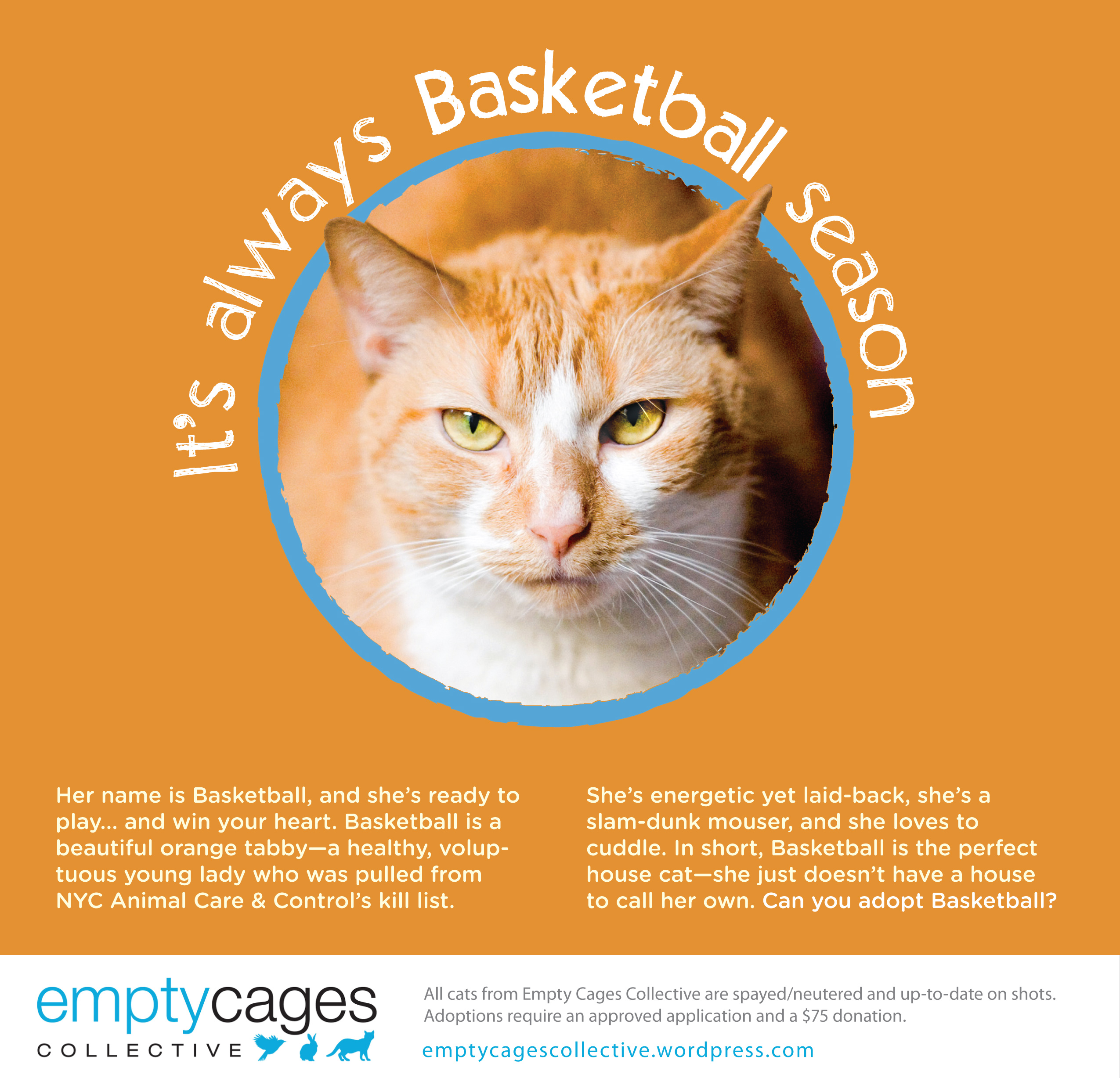
Her name is Basketball, and she's ready to play... and win your heart. Basketball is a beautiful orange tabby - a healthy, voluptuous young lady who was pulled from NYC Animal Care & Control's kill list.
She's energetic yet laid-back, she's a slam-dunk mouser, and she loves to cuddle. In short, Basketball is the perfect house cat - she just doesn't have a house to call her own. Can you adopt Basketball?
Open Hearts, Empty Cages: Mercury The Hen Finds Home Down South
March 22, 2010
Categories: Empty Cages
Mercury (right) with her good friend Doodle at Chocowinity Chicken Sanctuary in North Carolina
ECC Volunteer Staff Member Kelly with Mercury During a Dust-bathing SessionSome people don't look at chickens as a high priority for rescuing or deserving of compassion and care, with billions being killed each year for "food" and millions suffering to produce eggs in the US alone. Others are exploited, tormented, and killed in cock fighting and humiliating rituals like kaporos.
At Empty Cage Collective (ECC), we recognize chickens as the smart, funny, sentient beings they are, and if we can give them a helping hand or a better life, we will certainly try. The fact is, chickens are just as worthy of ethical and just treatment as any cat or dog. For one especially sweet and lucky hen named Mercury, life is now what it is supposed to be. Dusting, foraging, and living with her rooster friend Doodle at Chocowinity Chicken Sanctuary in North Carolina.
Mercury was found abandoned in a cemetery in Queens. She may have escaped a local live market where birds languish until being slaughtered for human consumption or was abandoned by someone who was "using" her for eggs and no longer had any use for her. Regardless, when ECC found out about Mercury's plight we agreed to take her into protective custody in order to provide temporary care and housing until a long-term home or sanctuary was found for her.
A volunteer staff member with Empty Cages Collective, plus 4 other native North Carolinans, happened to be taking a van down for the holidays and couldn't think of a better traveling companion than Mercury. After the 9-hour drive, Mercury and the humans couldn't be happier to reach their home. Once she arrived, it was like Mercury had always been there. She immediately covered her shiny black feathers with fresh dirt (dust bathed), started pecking for worms, and got to work removing debris from her new house. Seeing this picture, you would not believe she had ever come so close to something horrific happening to her. Her new roommate, Doodle, who was rescued after falling off a slaughterhouse-bound truck, fell in love at first sight and followed her everywhere. His natural chicken instincts were not as strong as Mercury's (he seemed a little lost until her arrival), but now he has grown into a strong protector, making sure nothing harms his beautiful hen.
We only wish all animals traditionally thought of as "food" were so lucky.
At Empty Cage Collective (ECC), we recognize chickens as the smart, funny, sentient beings they are, and if we can give them a helping hand or a better life, we will certainly try. The fact is, chickens are just as worthy of ethical and just treatment as any cat or dog. For one especially sweet and lucky hen named Mercury, life is now what it is supposed to be. Dusting, foraging, and living with her rooster friend Doodle at Chocowinity Chicken Sanctuary in North Carolina.
Mercury was found abandoned in a cemetery in Queens. She may have escaped a local live market where birds languish until being slaughtered for human consumption or was abandoned by someone who was "using" her for eggs and no longer had any use for her. Regardless, when ECC found out about Mercury's plight we agreed to take her into protective custody in order to provide temporary care and housing until a long-term home or sanctuary was found for her.
A volunteer staff member with Empty Cages Collective, plus 4 other native North Carolinans, happened to be taking a van down for the holidays and couldn't think of a better traveling companion than Mercury. After the 9-hour drive, Mercury and the humans couldn't be happier to reach their home. Once she arrived, it was like Mercury had always been there. She immediately covered her shiny black feathers with fresh dirt (dust bathed), started pecking for worms, and got to work removing debris from her new house. Seeing this picture, you would not believe she had ever come so close to something horrific happening to her. Her new roommate, Doodle, who was rescued after falling off a slaughterhouse-bound truck, fell in love at first sight and followed her everywhere. His natural chicken instincts were not as strong as Mercury's (he seemed a little lost until her arrival), but now he has grown into a strong protector, making sure nothing harms his beautiful hen.
We only wish all animals traditionally thought of as "food" were so lucky.
They Are All Oreo: How Oreo's Law Will Save Shelter Animals--And Help Stop Animal Abuse
March 11, 2010
Categories: Advocacy
Thin Valentine is looking for a home. Her and her friends need you to support and promote Oreo's Law.
Julio after returning from his neuter surgery. He went from possible hypothermia victim to possible kill statistic to a great home in about a week. Julio and his feline fellows need you to contact your NYS Assembly member and State Senator to support Oreo's Law.
Willie, AKA Joshua, was pulled from NYC Animal Care & Control\'s Kill List by Empty Cages Collective. At the time, he had a bad cold and needed surgery on his injured eye. He is now in a wonderful home. Many cats and kittens like Willie will have a chance at a life if Oreo's Law passes.
Oreo before being killed. Labor Organizer Mother Jones said it best: Pray for the dead and fight like hell for the living.It was only a month ago: February 2010. Bed Stuy, Brooklyn. The dog--a white pit bull with a black patch around her left eye--had been whining and barking and crying for days. Hungry, confused, hungry, tired, hungry. She would sit on the third-floor fire escape whining and then jump back into the open window of the abandoned house. She repeated this routine for hours, day after day, for at least a week.
A single question resonated repeatedly from the inside of her being: Why? Why was she left here? Why was there no food? Why was everything so scary? Why wouldn't anyone come to help her? WHY?
No one seemed to hear her cries. Finally, the continuous distressed barking and whining found the compassionate ear of a woman who lived in the building next door. The woman, Sam, started making phone calls searching for help for the dog, climbed down her own fire escape to throw food to the starving prisoner of the abandoned house, and worried about the dog's future. Eventually she called Empty Cages Collective (ECC) and Brooklyn Animal Foster Network (BAFN), as well as other organizations. BAFN volunteers rushed into action to access the abandoned building, gaining entry to the vacant apartment via the fire escape. BAFN rescued the dog and ferried her to safety and care in the form of food, veterinary treatment and temporary boarding. Then the work to find the dog (now named Valentine) a good, loving, permanent home began.
When an animal rescuer asked Sam why she didn't call for help sooner, she said she had tried but kept coming up with dead ends. Sam had been truly struggling with what to do for the young dog before BAFN intervened. Her quandary is one shared by many people concerned with stray, abused and homeless animals throughout the state of New York (and in fact, the nation). Sam didn't want to see the starving, abandoned dog "rescued" only to end up killed in a shelter that adheres to antiquated and unethical policies or attitudes that dictate killing for space, (treatable) health conditions and "behavioral problems" determined through archaic temperament testing. Sam had heard that many pit and pit bull mixes end up being killed at NYC Animal Care & Control, which they do. Even the ASPCA--an organization that, in recent years, stopped killing most healthy and treatable animals in its shelter--was known to kill pits rescued from abusive situations (e.g., Max, Oreo). Sam didn't want to send Valentine--already a victim of human cruelty and callousness--to be further victimized by being unnecessarily killed. No thinking, compassionate person could blame her.
Early the next morning, an Empty Cages Collective volunteer was shaken awake by the vibrating ringing of his cell phone. Barbara, the caller, was someone whose feral cat colony in Canarsie, Brooklyn, ECC had helped trap, sterilize and return. She was calling because someone had abandoned a small brown tabby kitten on her porch the night before, leaving nothing more than a box of food. The kitten was confused, terrified, and freezing! There was already several inches of snow on the ground, and more snow was coming. When ECC realized that the kitten had been left outside overnight and was found shaking uncontrollably at daybreak, we knew we had to help. ECC immediately agreed to accept the kitten (now known as Julio) into our adoption program. When asked why she didn't rescue the cat sooner, Barbara's reply was similar to Sam's. Barbara didn't want to take Julio to Brooklyn's Animal Care & Control, where he could be unnecessarily killed instead of being merely frightened and cold. "What would be the point of rescuing him just to turn him over to a place that would kill him?" Barbara asked. (Luckily for Julio, it only took about a week post-rescue for ECC to find him a terrific home!)
Much like Valentine the dog, Julio the kitten awaited rescue, suffering simply because the institutions in place to care for companion animals in crisis utilize killing as a method of problem-solving--a method that many members of the general public will not accept. The point is simple and yet profound: the public leaves animals in egregiously cruel, neglectful or unacceptable situations rather than bring those animals to shelters who kill healthy or treatable animals and show no active intention to stop. Animals stay in abusive situations because the institutions that are designed to help and protect them kill them instead. This ethical inconsistency has forced the public to remain hands off, refraining from reporting cruelty and neglect situations lest they aid and abet the killing of adoptable animals.
Oreo's Law (A. 9449/S. 6412), is New York State legislation proposed by Assemblyman Micah Kellner and State Senator Thomas Duane that has the potential to save the lives of countless puppies and kittens, dogs and cats, rabbits, guinea pigs and other companion animals who find themselves in animal control facilities in NY State. Oreo's Law (A. 9449/S. 6412), if passed, will make it illegal for an animal shelter, animal control establishment or pound to kill a healthy or treatable animal if a 501(c)3 non-profit animal rescue and adoption organization in good standing is willing to accept that animal into their rescue and adoption program. By legislating that no-kill shelters and rescue organizations have access to adoptable and medically treatable animals who are to be killed in shelters, the state of New York will send a clear, necessary message that killing healthy and treatable shelter animals is inhumane and should be avoided whenever viable alternatives exist. But that's not the whole story. Oreo's Law will have wonderful, broad-reaching consequences. In passing Oreo's Law, the state of New York will take the first step towards creating an environment where animals are not left in abusive and neglectful situations simply because their would be rescuers live in fear of making bad situations worse. Oreo's Law will represent a milestone in protecting animals in shelters. Furthermore, Oreo's Law, if passed, will enable, inspire and strengthen partnerships in the name of saving the lives of companion animals.
Throughout the state of New York, animals remain in less than ideal situations--sometimes abusive, often neglectful--simply because the traditional animal control model has created a false dichotomy of defeat: death or abuse. The apologists for these traditional shelters and animal control establishments tell us they are doing the best they can, that killing is currently necessary, and that animals who are leading imperfect lives in imperfect homes are better off dead. Yet conscience, intelligence and compassion show us the truth: No healthy or adoptable animal is "protected" through killing.
By reinforcing a schizophrenic paradigm where killing poses as love, the animal control establishment force the public to compromise the welfare of animals by asking them to do something they won't do: participate in a system that pulls animals from abusers only to unjustly end their lives--lives these animals value and struggle to keep intact. When killing is no longer treated as the go-to move for the countless animals entering traditional shelter establishments, existing humane alternatives will be utilized, perfected and expanded, while others will be discovered or created.
While justifications for killing abound, the truth is that shelters all over New York State kill animals who reputable and responsible animal rescue organizations are or would be willing to take, rehabilitate and place in loving homes. Animals are being killed in New York City, Rochester, Buffalo and cities and towns throughout the state because animal control establishments are not working with rescuers at all or will not work with them to the extent they could. Even in New York City, where NYC shelters do a better job working with rescue organizations than almost anywhere else in the state, animals are still killed while hardworking and knowledgeable individuals who run 501(c)3 non-profit animal rescues are denied the ability to pull animals destined to die.
Without Oreo's Law, there is no recourse for the animals and their rescuers when a pound, shelter or animal control establishment is determined to kill an animal for reasons other then irreparable suffering. Without Oreo's Law, healthy and treatable companion animals have no hope to live and find a loving home if the shelter they find themselves in has policies or staff determined to kill first and ask questions later. Just some of the individual animals who fall victim to unnecessary shelter killing are cats too terrified to show their true friendly selves, orphaned kittens and puppies young enough to need round-the-clock bottle-feeding, pit bulls in communities whose shelters have antiquated must-kill mandates on bully breed dogs, cats with slight colds and dogs with nothing more than a runny nose.
Right now as you read this, dogs and cats and other animals are marked to be "PTS" ("put to sleep") tomorrow morning or "EHR"'d ("euthanasia for humane reasons") tomorrow night at animal control establishments throughout New York State. Right now as you read this, 501(c)3 non-profit animal rescue and adoption organizations are willing to save many of those animals, incur the costs to provide food and veterinary care, and work hard to find those animals wonderful, loving homes--but will not be permitted to "pull" the animals from the establishments that will kill them. Those animals will be killed, just as Oreo was unnecessarily killed. Oreo's Law will save many of these lives and help to ensure that dogs like Valentine and kittens like Julio don't wait longer than absolutely necessary for help to arrive.
Oreo's Law will not bring back Oreo--the abused, but resilient dog who was killed when viable alternatives existed--but it will ensure that future "Oreos" (including tiny kittens, friendly cats, scared and hungry dogs, and even rabbits and hamsters) are given a fair shot at a good life. Oreo's Law is commonsense legislation that people who care about animals should vocally support for the thousands of animals who pass through shelters and rescue organizations--animals like Oreo, Max, Valentine, and Julio.
A single question resonated repeatedly from the inside of her being: Why? Why was she left here? Why was there no food? Why was everything so scary? Why wouldn't anyone come to help her? WHY?
No one seemed to hear her cries. Finally, the continuous distressed barking and whining found the compassionate ear of a woman who lived in the building next door. The woman, Sam, started making phone calls searching for help for the dog, climbed down her own fire escape to throw food to the starving prisoner of the abandoned house, and worried about the dog's future. Eventually she called Empty Cages Collective (ECC) and Brooklyn Animal Foster Network (BAFN), as well as other organizations. BAFN volunteers rushed into action to access the abandoned building, gaining entry to the vacant apartment via the fire escape. BAFN rescued the dog and ferried her to safety and care in the form of food, veterinary treatment and temporary boarding. Then the work to find the dog (now named Valentine) a good, loving, permanent home began.
When an animal rescuer asked Sam why she didn't call for help sooner, she said she had tried but kept coming up with dead ends. Sam had been truly struggling with what to do for the young dog before BAFN intervened. Her quandary is one shared by many people concerned with stray, abused and homeless animals throughout the state of New York (and in fact, the nation). Sam didn't want to see the starving, abandoned dog "rescued" only to end up killed in a shelter that adheres to antiquated and unethical policies or attitudes that dictate killing for space, (treatable) health conditions and "behavioral problems" determined through archaic temperament testing. Sam had heard that many pit and pit bull mixes end up being killed at NYC Animal Care & Control, which they do. Even the ASPCA--an organization that, in recent years, stopped killing most healthy and treatable animals in its shelter--was known to kill pits rescued from abusive situations (e.g., Max, Oreo). Sam didn't want to send Valentine--already a victim of human cruelty and callousness--to be further victimized by being unnecessarily killed. No thinking, compassionate person could blame her.
Early the next morning, an Empty Cages Collective volunteer was shaken awake by the vibrating ringing of his cell phone. Barbara, the caller, was someone whose feral cat colony in Canarsie, Brooklyn, ECC had helped trap, sterilize and return. She was calling because someone had abandoned a small brown tabby kitten on her porch the night before, leaving nothing more than a box of food. The kitten was confused, terrified, and freezing! There was already several inches of snow on the ground, and more snow was coming. When ECC realized that the kitten had been left outside overnight and was found shaking uncontrollably at daybreak, we knew we had to help. ECC immediately agreed to accept the kitten (now known as Julio) into our adoption program. When asked why she didn't rescue the cat sooner, Barbara's reply was similar to Sam's. Barbara didn't want to take Julio to Brooklyn's Animal Care & Control, where he could be unnecessarily killed instead of being merely frightened and cold. "What would be the point of rescuing him just to turn him over to a place that would kill him?" Barbara asked. (Luckily for Julio, it only took about a week post-rescue for ECC to find him a terrific home!)
Much like Valentine the dog, Julio the kitten awaited rescue, suffering simply because the institutions in place to care for companion animals in crisis utilize killing as a method of problem-solving--a method that many members of the general public will not accept. The point is simple and yet profound: the public leaves animals in egregiously cruel, neglectful or unacceptable situations rather than bring those animals to shelters who kill healthy or treatable animals and show no active intention to stop. Animals stay in abusive situations because the institutions that are designed to help and protect them kill them instead. This ethical inconsistency has forced the public to remain hands off, refraining from reporting cruelty and neglect situations lest they aid and abet the killing of adoptable animals.
Oreo's Law (A. 9449/S. 6412), is New York State legislation proposed by Assemblyman Micah Kellner and State Senator Thomas Duane that has the potential to save the lives of countless puppies and kittens, dogs and cats, rabbits, guinea pigs and other companion animals who find themselves in animal control facilities in NY State. Oreo's Law (A. 9449/S. 6412), if passed, will make it illegal for an animal shelter, animal control establishment or pound to kill a healthy or treatable animal if a 501(c)3 non-profit animal rescue and adoption organization in good standing is willing to accept that animal into their rescue and adoption program. By legislating that no-kill shelters and rescue organizations have access to adoptable and medically treatable animals who are to be killed in shelters, the state of New York will send a clear, necessary message that killing healthy and treatable shelter animals is inhumane and should be avoided whenever viable alternatives exist. But that's not the whole story. Oreo's Law will have wonderful, broad-reaching consequences. In passing Oreo's Law, the state of New York will take the first step towards creating an environment where animals are not left in abusive and neglectful situations simply because their would be rescuers live in fear of making bad situations worse. Oreo's Law will represent a milestone in protecting animals in shelters. Furthermore, Oreo's Law, if passed, will enable, inspire and strengthen partnerships in the name of saving the lives of companion animals.
Throughout the state of New York, animals remain in less than ideal situations--sometimes abusive, often neglectful--simply because the traditional animal control model has created a false dichotomy of defeat: death or abuse. The apologists for these traditional shelters and animal control establishments tell us they are doing the best they can, that killing is currently necessary, and that animals who are leading imperfect lives in imperfect homes are better off dead. Yet conscience, intelligence and compassion show us the truth: No healthy or adoptable animal is "protected" through killing.
By reinforcing a schizophrenic paradigm where killing poses as love, the animal control establishment force the public to compromise the welfare of animals by asking them to do something they won't do: participate in a system that pulls animals from abusers only to unjustly end their lives--lives these animals value and struggle to keep intact. When killing is no longer treated as the go-to move for the countless animals entering traditional shelter establishments, existing humane alternatives will be utilized, perfected and expanded, while others will be discovered or created.
While justifications for killing abound, the truth is that shelters all over New York State kill animals who reputable and responsible animal rescue organizations are or would be willing to take, rehabilitate and place in loving homes. Animals are being killed in New York City, Rochester, Buffalo and cities and towns throughout the state because animal control establishments are not working with rescuers at all or will not work with them to the extent they could. Even in New York City, where NYC shelters do a better job working with rescue organizations than almost anywhere else in the state, animals are still killed while hardworking and knowledgeable individuals who run 501(c)3 non-profit animal rescues are denied the ability to pull animals destined to die.
Without Oreo's Law, there is no recourse for the animals and their rescuers when a pound, shelter or animal control establishment is determined to kill an animal for reasons other then irreparable suffering. Without Oreo's Law, healthy and treatable companion animals have no hope to live and find a loving home if the shelter they find themselves in has policies or staff determined to kill first and ask questions later. Just some of the individual animals who fall victim to unnecessary shelter killing are cats too terrified to show their true friendly selves, orphaned kittens and puppies young enough to need round-the-clock bottle-feeding, pit bulls in communities whose shelters have antiquated must-kill mandates on bully breed dogs, cats with slight colds and dogs with nothing more than a runny nose.
Right now as you read this, dogs and cats and other animals are marked to be "PTS" ("put to sleep") tomorrow morning or "EHR"'d ("euthanasia for humane reasons") tomorrow night at animal control establishments throughout New York State. Right now as you read this, 501(c)3 non-profit animal rescue and adoption organizations are willing to save many of those animals, incur the costs to provide food and veterinary care, and work hard to find those animals wonderful, loving homes--but will not be permitted to "pull" the animals from the establishments that will kill them. Those animals will be killed, just as Oreo was unnecessarily killed. Oreo's Law will save many of these lives and help to ensure that dogs like Valentine and kittens like Julio don't wait longer than absolutely necessary for help to arrive.
Oreo's Law will not bring back Oreo--the abused, but resilient dog who was killed when viable alternatives existed--but it will ensure that future "Oreos" (including tiny kittens, friendly cats, scared and hungry dogs, and even rabbits and hamsters) are given a fair shot at a good life. Oreo's Law is commonsense legislation that people who care about animals should vocally support for the thousands of animals who pass through shelters and rescue organizations--animals like Oreo, Max, Valentine, and Julio.
Open Hearts, Empty Cages: Biggles Finds Love
February 14, 2010
Categories: Empty Cages
One evening, an employee of Foodswings, a local vegan restaurant, called an ECC volunteer she knew and asked him to come rescue a stray mother cat and her two kittens. The feline family was about a block away from the restaurant and seemed very hungry. ECC flew into action to retrieve the starved, shy mother cat and her young.
Biggles and her two kittens, Basil and Dakota, were quickly brought to our shelter space. Biggles was a good mother and both kittens were healthy but shy. Unfortunately, it's difficult to find an adopter willing to take on three cats at once, so we set out to find them all good homes, whether together or separate. The kittens found homes fairly quickly, but Biggles remained with us for a little longer. She became very friendly with the ECC volunteers, and we knew her outgoing personality and funny face would help her find a home.
Kate wanted a cat who was social. She lives with two roommates and often has guests over. Once Kate met Biggles, she knew that Biggles had the personality she was looking for. As for being shy in her new home, that didn't happen with Biggles! Biggles settled into her new home immediately. As Kate tells us, "As soon as you left, she started hanging out with us all the time . . . She is always laying around on the couch or running back and forth around the apartment. She's a very happy, well-adjusted cat who is friendly with everyone who comes by!"
Biggles and her kittens are now all in wonderful, loving, permanent homes. That's the best outcome we could have wished for!
Biggles and her two kittens, Basil and Dakota, were quickly brought to our shelter space. Biggles was a good mother and both kittens were healthy but shy. Unfortunately, it's difficult to find an adopter willing to take on three cats at once, so we set out to find them all good homes, whether together or separate. The kittens found homes fairly quickly, but Biggles remained with us for a little longer. She became very friendly with the ECC volunteers, and we knew her outgoing personality and funny face would help her find a home.
Kate wanted a cat who was social. She lives with two roommates and often has guests over. Once Kate met Biggles, she knew that Biggles had the personality she was looking for. As for being shy in her new home, that didn't happen with Biggles! Biggles settled into her new home immediately. As Kate tells us, "As soon as you left, she started hanging out with us all the time . . . She is always laying around on the couch or running back and forth around the apartment. She's a very happy, well-adjusted cat who is friendly with everyone who comes by!"
Biggles and her kittens are now all in wonderful, loving, permanent homes. That's the best outcome we could have wished for!
Open Hearts, Empty Cages: Colette Goes Home
January 30, 2010
Categories: Empty Cages
Colette was found wandering around as a stray, pregnant and hungry, in Fort Greene, Brooklyn. While she was in good health when she was found, she was clearly familiar with being around people. Perhaps someone dumped her there thinking the area would be a refuge for her. Unfortunately, it was not. We took her in, cleaned her up a little, got her veterinary care, and set out to find her a new home.
When Alison came to our shelter space, she spent some time looking at all of our adoptable cats, but she kept coming back to Colette. In the end, Colette's beauty, extra friendly personality, and funny husky voice won her over.
Alison says, "She's the sweetest and most hilarious cat I've ever known, and I'm so glad to have her. She gives kisses and sleeps next to my head and purrs like a motor when I come home."
Alison also shared this story with us. "I went home to Texas for the holidays and brought her along with me. She was the perfect traveler. While at home, I had to have emergency surgery to remove my gallbladder, and I'm really glad I had her with me. She was a very nice companion while recovering. I've included a picture of her laying on me which she only did while I was feeling particularly bad. So sweet!"
Alison adds, "Thank you all for everything you do for these animals, and I am so grateful and thankful that you kept Colette for me until I could find her."
When Alison came to our shelter space, she spent some time looking at all of our adoptable cats, but she kept coming back to Colette. In the end, Colette's beauty, extra friendly personality, and funny husky voice won her over.
Alison says, "She's the sweetest and most hilarious cat I've ever known, and I'm so glad to have her. She gives kisses and sleeps next to my head and purrs like a motor when I come home."
Alison also shared this story with us. "I went home to Texas for the holidays and brought her along with me. She was the perfect traveler. While at home, I had to have emergency surgery to remove my gallbladder, and I'm really glad I had her with me. She was a very nice companion while recovering. I've included a picture of her laying on me which she only did while I was feeling particularly bad. So sweet!"
Alison adds, "Thank you all for everything you do for these animals, and I am so grateful and thankful that you kept Colette for me until I could find her."
Opossums & Skunks Need Advocates, Too
January 24, 2010
Categories: Advocacy
Skunks aren't vermin - they're just neighbors.
Opossums are North America\'s only marsupial - and are entitled to be treated like thinking, feeling beings not "pests"
On Wednesday, January 20th, the Daily News reported that the human residents of a public housing complex in the Bronx are "terrified" to leave their homes after dark because of the recent activity of wild skunks and opossums in their neighborhood. For those of us who have worked with and advocate for skunks and opossums, this would be funny if we didn't know what this unfounded fear generally results in: killing and cruelty towards urban wildlife. Empty Cages Collective's wildlife rehabilitator fired off a letter to the editor in response to the Daily News article:
"Skunks and opossums are native New York City residents who deserve our respect and compassion, not fear and hostility ("Residents of Throggs Neck Houses fear possums, skunks, but officials say little can be done," Kerry Burke, 1/20/2010). Skunks and opossums are wild sentient beings who play an invaluable role in our urban ecology. They eat mice, rats, and insects, and provide food for other wild animals like hawks and owls. We owe these wild animals admiration for their resilience in surviving in an increasingly hostile human-centered world.
By refraining from leaving cat or dog food or accessible human trash outside at night and using repellents (kitty litter can be placed near or inside of a skunk den site to encourage her to move on, or commercial or homemade capsaicin or castor oil repellents may also be used) and exercising simple tolerance, humans and urban wildlife can coexist in peace.
Relocation or trapping and killing urban wildlife is an ineffective and cruel response to unfounded fears about these creatures. As journalist Dorothy Thompson once wrote, "The most destructive element in the human mind is fear. Fear creates aggressiveness." Throggs Neck residents should let go of some of their fears and be open to the idea that their four-footed neighbors have a place in the nabe."
We can only hope that the residents of Throggs Neck learn to appreciate the wildlife around them. Thankfully, resouces like Wildlifehotline.org and the excellent book Wild Neighbors make it easier for people to resolve conflicts with wildlife humanely, as well as appreciate the role wildlife play in their native ecosystems!
By refraining from leaving cat or dog food or accessible human trash outside at night and using repellents (kitty litter can be placed near or inside of a skunk den site to encourage her to move on, or commercial or homemade capsaicin or castor oil repellents may also be used) and exercising simple tolerance, humans and urban wildlife can coexist in peace.
Relocation or trapping and killing urban wildlife is an ineffective and cruel response to unfounded fears about these creatures. As journalist Dorothy Thompson once wrote, "The most destructive element in the human mind is fear. Fear creates aggressiveness." Throggs Neck residents should let go of some of their fears and be open to the idea that their four-footed neighbors have a place in the nabe."
We can only hope that the residents of Throggs Neck learn to appreciate the wildlife around them. Thankfully, resouces like Wildlifehotline.org and the excellent book Wild Neighbors make it easier for people to resolve conflicts with wildlife humanely, as well as appreciate the role wildlife play in their native ecosystems!
ECC Rescues West Village Roosters!
January 22, 2010
Categories: Rescue
One of the roosters Empty Cages Collective rescued from Laguardia Corner Gardens in the West Village. This young man had a severe respiratory infection that required antibiotics when we received him!Empty Cages Collective (ECC) has been called on repeatedly to rescue abandoned hens and roosters throughout New York City. A handful of the most recent rescues were abandoned at Laguardia Corner Gardens in the West Village.
Rescuing these birds is resource intensive for ECC, since we often need to transport the birds far distances to well-run farmed animal sanctuaries where the birds will never be at risk of being harmed again (through abandonment, being eaten, bred, fought, etc.).
The New York Times recently reported on our simple request to the people abandoning the birds at Laguardia Corner Gardens: Stop. Chickens, like all animals deserve to be treated with compassion and respect - and should not be abandoned any more then they should be abused on factory farms, fought in cockfighting rings, or otherwise cruelly treated.
Open Hearts, Empty Cages: Fern Finds A Home For The Holidays
January 15, 2010
Categories: Empty Cages
Fern came to us as a stray from the streets of Crown Heights, Brooklyn. One of her eyes was damaged from an inner ear infection that she had contracted on the streets. After visiting the wonderful veterinarians at Manhattan Cat Specialists she was found to be in need of some antibiotics but otherwise healthy. She recovered from her infection except for some slight damage to her one eye.
Joe and Pam were looking for a new friend after Joe's cat passed away of old age. They took to Fern because of her outgoing personality and her gentle pleas for more petting. They decided to take her home right before the holidays, even though it was a stressful time of year. They took a chance and welcomed her into their home a week before their holiday trip. Everyone is glad they did!
According to Joe, "She traveled amazingly well and was very comfortable at my parents' place over the holiday. She traveled back to Brooklyn with similar ease and has thoroughly settled in. Pam and I are both amazed at how sweet she is. She loves to be around us, and only occasionally walks across the keyboard as we are typing. She even lets us trim her nails (as long as we only do a couple at a time). Basically, she's perfect."
From the streets of Crown Heights to a cozy apartment in Greenpoint, Brooklyn, Fern's journey had a very happy ending. We hope for a day when all friendly felines get such breaks in life!
Joe and Pam were looking for a new friend after Joe's cat passed away of old age. They took to Fern because of her outgoing personality and her gentle pleas for more petting. They decided to take her home right before the holidays, even though it was a stressful time of year. They took a chance and welcomed her into their home a week before their holiday trip. Everyone is glad they did!
According to Joe, "She traveled amazingly well and was very comfortable at my parents' place over the holiday. She traveled back to Brooklyn with similar ease and has thoroughly settled in. Pam and I are both amazed at how sweet she is. She loves to be around us, and only occasionally walks across the keyboard as we are typing. She even lets us trim her nails (as long as we only do a couple at a time). Basically, she's perfect."
From the streets of Crown Heights to a cozy apartment in Greenpoint, Brooklyn, Fern's journey had a very happy ending. We hope for a day when all friendly felines get such breaks in life!
Another Brooklyn Group Supports Oreo's Law--Now, It's Your Turn!
January 5, 2010
Categories: Advocacy
Basketball was pulled from the kill list at Animal Care & Control by Empty Cages. Should she have died if a shelter director decided he or she didn't want to work with ECC? Oreo's Law would provided needed protection for cats like Basketball.Oreo's Law aims to save lives in New York State--and if it passes, it will. Oreo's Law--once passed--would make it illegal for an animal shelter or an animal control facility to kill a healthy or medically or behaviorally treatable animal if another legitimate non-profit animal rescue organization is willing to take the animal. Some establishments have policies to kill cats because they are feral; others kill kittens because they have colds or are still nursing and not completely weaned. Currently, there is no recourse for animal rescue organizations to protect animals from being unnecessarily killed if another animal sheltering establishment is determined to do so.
Laurie Bleier, director of the Brooklyn Animal Foster Network, an animal rescue organization, recently wrote: "My name is Laurie Bleier and I am the director of the Brooklyn Animal Foster Network. My group is one of many groups which were banned from removing animals from the Animal Care & Control of New York City (NYCACC) by past executive director Charlene Pedrolie.
In the two years before our suspension, we removed more than 1,000 animals from NYCACC as New Hope Partners, through our Care-A-Van adoption events with State Senator Erik Addams. Every weekend, Spring, Summer and Fall, you could see us on Seventh Avenue in Park Slope with 15 or more animals we just picked up from the Brooklyn Center on Linden Blvd. Many from the euthanasia list.
Shortly after Ms. Pedrolie began her tenure, she informed me unceremoniously that my group was banned because one of my dogs in foster care was found to be emaciated. After a thorough investigation by the ASPCA Humane Law Enforcement those charges were found to be completely baseless and the case was dropped. You can call Officer Joe Pentangelo at (212) 876-7700, ext. 4450 for confirmation of this.
Despite our complete exoneration, Ms. Pedrolie refused to give us back our New Hope status. In the 2 and 1/2 years that we have not had due process to regain our status we estimate more than 1,000 cats and dogs needlessly perished because one person could not admit she made a mistake. No one should have that kind of power over helpless animals.
Additionally, there was no response to countless letters of protest written to the board members of Animal Care & Control of New York City by hundreds of outraged New York animal loving citizens who knew our work.
And now, to our utter disbelief, the new Interim Director recently told me that Ms. Charlene Pedrolie's countless, capricious suspensions are not a priority for her. Seems a few more hundred animals will die under her temporary tenure.
Please feel free to use my story as a powerful reason to enact immediately Oreo's Law."
Please contact Assembly Member Micah Z. Kellner and State Senator Thomas K. Duane and thank them for their work to protect shelter animals! Their contact information is available on their websites.
If you're a New York State resident, PLEASE write, call AND email your Assembly Member and State Senator and ask them to support (and ideally co-sponsor) Assemblyman Micah Kellner and State Senator Thomas Duane's "Oreo's Law": a law that will protect countless companion animals from being unnecessarily destroyed when alternatives exist. You can find your New York State representatives here. You also get this information by calling the League of Women Voters of the City of New York's Telephone Information Service at 212-725-3541.
Please keep Empty Cages Collective in the loop about responses you get!
Laurie Bleier, director of the Brooklyn Animal Foster Network, an animal rescue organization, recently wrote: "My name is Laurie Bleier and I am the director of the Brooklyn Animal Foster Network. My group is one of many groups which were banned from removing animals from the Animal Care & Control of New York City (NYCACC) by past executive director Charlene Pedrolie.
In the two years before our suspension, we removed more than 1,000 animals from NYCACC as New Hope Partners, through our Care-A-Van adoption events with State Senator Erik Addams. Every weekend, Spring, Summer and Fall, you could see us on Seventh Avenue in Park Slope with 15 or more animals we just picked up from the Brooklyn Center on Linden Blvd. Many from the euthanasia list.
Shortly after Ms. Pedrolie began her tenure, she informed me unceremoniously that my group was banned because one of my dogs in foster care was found to be emaciated. After a thorough investigation by the ASPCA Humane Law Enforcement those charges were found to be completely baseless and the case was dropped. You can call Officer Joe Pentangelo at (212) 876-7700, ext. 4450 for confirmation of this.
Despite our complete exoneration, Ms. Pedrolie refused to give us back our New Hope status. In the 2 and 1/2 years that we have not had due process to regain our status we estimate more than 1,000 cats and dogs needlessly perished because one person could not admit she made a mistake. No one should have that kind of power over helpless animals.
Additionally, there was no response to countless letters of protest written to the board members of Animal Care & Control of New York City by hundreds of outraged New York animal loving citizens who knew our work.
And now, to our utter disbelief, the new Interim Director recently told me that Ms. Charlene Pedrolie's countless, capricious suspensions are not a priority for her. Seems a few more hundred animals will die under her temporary tenure.
Please feel free to use my story as a powerful reason to enact immediately Oreo's Law."
Please contact Assembly Member Micah Z. Kellner and State Senator Thomas K. Duane and thank them for their work to protect shelter animals! Their contact information is available on their websites.
If you're a New York State resident, PLEASE write, call AND email your Assembly Member and State Senator and ask them to support (and ideally co-sponsor) Assemblyman Micah Kellner and State Senator Thomas Duane's "Oreo's Law": a law that will protect countless companion animals from being unnecessarily destroyed when alternatives exist. You can find your New York State representatives here. You also get this information by calling the League of Women Voters of the City of New York's Telephone Information Service at 212-725-3541.
Please keep Empty Cages Collective in the loop about responses you get!
He's Clinton. He Needs A Home!
January 4, 2010
Categories: Adoptables
Please print out our new adoption poster for our friend Clinton and widely distribute. Help us find him a home.
ECC Helps Ailing Red-tailed Hawk on Christmas
December 31, 2009
Categories: Rescue
Empty Cages Collective is always busy - even on December 25th, Christmas day. We were called by staff at Manhattan's Animal Care & Control (ACC) to assist with an injured Red-tailed Hawk who they didn't know how to handle properly. ECC volunteers quickly flew into action to pick up the ailing bird and transport her to a Federally-licensed raptor rehabilitator in Long Island. When we arrived at ACC, we realized they were housing the debilitated bird inappropriately (wire cages), so we quickly moved her into a hard, covered animal carrier. Injured and orphaned wild birds should never be transported or kept in wire cages because they can do severe damage to their feathers and faces which impedes their ability to be eventually released. For tips on how to handle injured hawks, in case you should ever encounter one, check out the tips offered by The Raptor Trust, Hawk Haven, or the University of Minnesota's Raptor Center. In any case, within a few minutes at ACC, ECC volunteers were on their way to get the young hawk some help!
After transporting the juvenile red-tailed hawk to a raptor rehabilitator, a ECC volunteer quickly drafted a letter to officials at ACC asking, in part: "Can a policy be instituted for medical staff and everyone at ACC handling wild birds that the birds are kept in solid boxes or carriers, and are kept warm, dark and quiet until they are transported to rehabilitators or veterinarians? A wild bird's chances of rehabilitation and release back into his or her habitat should be improved by his or her run-in with ACC, not impeded. I have included a picture of the hawk as I found her - if you look closely enough you can see her tail feathers becoming ragged from rubbing against and through the cage." We have been given assurances that distressed raptors will be handled better in the future.
The better news is, the Red-tailed Hawk is likely to recover and will eventually be released back into the wild where she belongs!
After transporting the juvenile red-tailed hawk to a raptor rehabilitator, a ECC volunteer quickly drafted a letter to officials at ACC asking, in part: "Can a policy be instituted for medical staff and everyone at ACC handling wild birds that the birds are kept in solid boxes or carriers, and are kept warm, dark and quiet until they are transported to rehabilitators or veterinarians? A wild bird's chances of rehabilitation and release back into his or her habitat should be improved by his or her run-in with ACC, not impeded. I have included a picture of the hawk as I found her - if you look closely enough you can see her tail feathers becoming ragged from rubbing against and through the cage." We have been given assurances that distressed raptors will be handled better in the future.
The better news is, the Red-tailed Hawk is likely to recover and will eventually be released back into the wild where she belongs!
The Social & Secret Life of Chickens Lecture: Wednesday, December 30th
December 27, 2009
Categories: Education
Mercury - a sweet and gentle rooster - was rescued from a fighting cock ring and scheduled to be killed at animal control. Empty Cages intervened and saved his life.
"With increased knowledge of the behaviour and cognitive abilities of the chicken, has come the realization that the chicken is not an inferior species to be treated merely as a food source." ~ Dr. Lesley J. Rogers, Professor of Animal Behavior
United Poultry Concerns President Karen Davis will be present a lecture on "The Social & Secret Life of Chickens: A Lecture with Visuals & a Book-Signing" on Wednesday, December 30, 2009. The lecture will be held at the Mid-Manhattan Library, 455 5th Avenue, New York City on Wednesday, December 30 at 6:30 PM. Immediately after the lecture, Karen Davis will sign copies of her important book Prisoned Chickens, Poisoned Eggs: An Inside Look at the Modern Poultry Industry
Karen Davis' over 20 years experience with chickens has shown her that chickens are conscious and emotional beings with adaptable sociability and a range of intentions and personalities. She will relate her personal stories about the chickens at the sanctuary to how chickens are treated in factory farming and live poultry markets.
United Poultry Concerns President Karen Davis will be present a lecture on "The Social & Secret Life of Chickens: A Lecture with Visuals & a Book-Signing" on Wednesday, December 30, 2009. The lecture will be held at the Mid-Manhattan Library, 455 5th Avenue, New York City on Wednesday, December 30 at 6:30 PM. Immediately after the lecture, Karen Davis will sign copies of her important book Prisoned Chickens, Poisoned Eggs: An Inside Look at the Modern Poultry Industry
Karen Davis' over 20 years experience with chickens has shown her that chickens are conscious and emotional beings with adaptable sociability and a range of intentions and personalities. She will relate her personal stories about the chickens at the sanctuary to how chickens are treated in factory farming and live poultry markets.
Thanks St. Saviour!
December 26, 2009
Categories: Supporters
ECC depends on the support of people like you! Without it, we can't continue to rescue animals like Jaimey - who would have been unnecessarily killed without our intervention.Empty Cages Collective wants to thank our friends at St. Saviour High School - especially teacher Anthony Tricarico and the young women in the school's Roots "N" Shoots chapter for their recent holiday needs drive for our animal rescue efforts!
Thanks to the folks at St. Saviour - we received much needed cleaning supplies, animal carriers, cat toys, and food for our rescued animals! As an all-volunteer, non-funded animal advocacy and protection organization, ECC always appreciates the donation of needed supplies! Thanks again St. Saviour!
Did your food have a face... and a tool?
December 17, 2009
Categories: Education
"Every creature is better alive than dead, men and moose and pine trees, and he who understands it aright will rather preserve its life than destroy it - Henry David Thoreau"
According to the Associated Press, Australian scientists have discovered a species of octopus in Indonesia that collects coconut shells for shelter - a sophisticated type of behavior that scientists long ago thought unique to human beings.
From the Associated Press article: "The scientists filmed the veined octopus, Amphioctopus marginatus, selecting halved coconut shells from the sea floor, emptying them out, carrying them under their bodies up to 65 feet (20 meters), and assembling two shells together to make a spherical hiding spot."
Octopuses are intelligent, invertebrate, sentient beings who seem to make plans for the future to protect themselves from harm. If we can live healthfully without harming (eating) octopus and other animals - from the sea or otherwise - shouldn't we do so?
From the Associated Press article: "The scientists filmed the veined octopus, Amphioctopus marginatus, selecting halved coconut shells from the sea floor, emptying them out, carrying them under their bodies up to 65 feet (20 meters), and assembling two shells together to make a spherical hiding spot."
Octopuses are intelligent, invertebrate, sentient beings who seem to make plans for the future to protect themselves from harm. If we can live healthfully without harming (eating) octopus and other animals - from the sea or otherwise - shouldn't we do so?
Open Hearts, Empty Cages: Rocco Gets Lucky!
December 12, 2009
Categories: Empty Cages
Rocco was brought to Empty Cages Collective (ECC) by volunteer Christopher Bollman - a tireless advocate for stray and feral cats and a big help to ECC. ECC has worked with Christopher to sterilize the free-roaming felines who call his block home. Many of these cats are feral - having no interest in being roommates with humans. Rocco, however, was different.
Rocco was already socialized - most likely lost or abandoned by his caretakers - when Christopher first met him on his street. More then just being friendly, Rocco wasn't interested in living the stray cat life and was actively trying to convince someone to take him in off the street. ECC decided to offer a helping hand.
ECC got Rocco neutered, vaccinated, treated for parasites, and tested for feline leukemia and FIV - and accepted him into our adoption program. Rocco then waited (not-so-patiently!) for a chance to find a permanent home.
Fast forward a few months, and ECC's friend Tim Soter decided it was time to adopt another feline friend. Rocco was finally chosen! No more cold nights on the street and no more kitty incarceration in a cage. Rocco would finally have a home to call his own.
Tim recently wrote to us about his buddy Rocco: "He is great mix of teenage exuberance and calm sweetness. He's really a great cat and it's great to get him out of a cage and into a bigger space for him to run around and play with toys."
Rocco was already socialized - most likely lost or abandoned by his caretakers - when Christopher first met him on his street. More then just being friendly, Rocco wasn't interested in living the stray cat life and was actively trying to convince someone to take him in off the street. ECC decided to offer a helping hand.
ECC got Rocco neutered, vaccinated, treated for parasites, and tested for feline leukemia and FIV - and accepted him into our adoption program. Rocco then waited (not-so-patiently!) for a chance to find a permanent home.
Fast forward a few months, and ECC's friend Tim Soter decided it was time to adopt another feline friend. Rocco was finally chosen! No more cold nights on the street and no more kitty incarceration in a cage. Rocco would finally have a home to call his own.
Tim recently wrote to us about his buddy Rocco: "He is great mix of teenage exuberance and calm sweetness. He's really a great cat and it's great to get him out of a cage and into a bigger space for him to run around and play with toys."
Pelfry Wants To Be The King Of Your Castle
December 11, 2009
Categories: Adoptables
Special Duffy Needs A Friend...
December 8, 2009
Categories: Adoptables
ECC Helps 16 Budgies Fly Away From A Bad Situation
December 7, 2009
Categories: Rescue
Working in conjunction with the Mayor's Alliance for NYC's Animals and the Avian Welfare Coalition, Empty Cages Collective (ECC) assisted with a rescue situation involving 16 budgies who had been denied proper veterinary care. had been bred and were now unwanted by their "caretaker."
ECC helped coordinate and organize the actual rescue of the budgies, as well as provided temporary foster care until the beautiful birds could be transported to a sanctuary where they would no longer be denied proper care, bred, or otherwise harmed. In fact, in their new home they will have a huge aviary where they will be able to fly freely - something all birds want and deserve.
Empty Cages Collective believes all naturally wild birds - from budgies to macaws to lorikeets - deserve to live freely in their native habitats and not be imprisoned in cages as "pets". Until such a day arrives, ECC will continue to do what we can to assist, place and advocate for the avian refugees of the exotic pet trade.
ECC helped coordinate and organize the actual rescue of the budgies, as well as provided temporary foster care until the beautiful birds could be transported to a sanctuary where they would no longer be denied proper care, bred, or otherwise harmed. In fact, in their new home they will have a huge aviary where they will be able to fly freely - something all birds want and deserve.
Empty Cages Collective believes all naturally wild birds - from budgies to macaws to lorikeets - deserve to live freely in their native habitats and not be imprisoned in cages as "pets". Until such a day arrives, ECC will continue to do what we can to assist, place and advocate for the avian refugees of the exotic pet trade.
IMPORTANT! Help Pass "Oreo's Law"
December 4, 2009
Categories: Advocacy
In June 2009, a one year old dog named Oreo was thrown from the sixth floor of a Brooklyn rooftop. The perpetrator was arrested and Oreo - with broken bones and fractured ribs - was "rescued" and taken to the American Society for the Prevention of Cruelty to Animals (ASPCA). The ASPCA started treating her broken body and she began to recover. She was quickly deemed the "miracle dog," and a happy ending seemed possible. As Nathan Winograd, animal sheltering expert and advocate points out: the miracle was short-lived.
According to the ASPCA, Oreo - a dog traumatized and abused by humans - was showing some aggression towards the same species that had thrown her off of a roof and nearly killed her. While Oreo's body had healed, she was still (unsurprisingly) distrustful and stressed by some people. Ed Sayres, President of the ASPCA made the decision to kill her due to this alleged behavior. Before she was killed, Pets Alive, a no-kill animal shelter located in the foothills of the Catskill Mountains, contacted the ASPCA to ask for custody of Oreo. Pets Alive is a reputable, approved animal rescue organization with experience in handling dogs deemed aggressive. Pets Alive contacted the ASPCA repeatedly requesting custody of Oreo. The ASPCA refused. The ASPCA then killed Oreo.
Oreo, abused and possibly beaten before entering the ASPCA, thrown from a roof and injured, was "rescued" only to be killed far before her time, without being given a chance at rehabilitation - even when a responsible organization was willing to work with her and foot the bill.
This has led Assembly Member Micah Z. Kellner and Senator Thomas K. Duane to introduce "Oreo's Law". "Oreo's Law" will grant legitimate animal protection and welfare organizations the right to request healthy and treatable animals be given to their care when a shelter is planning on killing them. A similar law already exists in California, and has saved countless animals from unnecessary and untimely death at the hands of animal control and sheltering establishments.
Please help make sure that Oreo is the last companion animal in New York State who is killed when a responsible animal rescue alternative exists!
Please contact Assembly Member Micah Z. Kellner and State Senator Thomas K. Duane and thank them for their work to protect shelter animals! Their contact information is available on their websites.
If you're a New York State resident, PLEASE write, call AND email your Assembly Member and State Senator and ask them to support (and ideally co-sponsor) Assemblyman Micah Kellner and State Senator Tomas Duane's "Oreo's Law": a law that will protect countless companion animals from being unnecessarily destroyed when alternatives exist. You can find your New York State representatives here.
Please keep Empty Cages Collective in the loop about responses you get!
According to the ASPCA, Oreo - a dog traumatized and abused by humans - was showing some aggression towards the same species that had thrown her off of a roof and nearly killed her. While Oreo's body had healed, she was still (unsurprisingly) distrustful and stressed by some people. Ed Sayres, President of the ASPCA made the decision to kill her due to this alleged behavior. Before she was killed, Pets Alive, a no-kill animal shelter located in the foothills of the Catskill Mountains, contacted the ASPCA to ask for custody of Oreo. Pets Alive is a reputable, approved animal rescue organization with experience in handling dogs deemed aggressive. Pets Alive contacted the ASPCA repeatedly requesting custody of Oreo. The ASPCA refused. The ASPCA then killed Oreo.
Oreo, abused and possibly beaten before entering the ASPCA, thrown from a roof and injured, was "rescued" only to be killed far before her time, without being given a chance at rehabilitation - even when a responsible organization was willing to work with her and foot the bill.
This has led Assembly Member Micah Z. Kellner and Senator Thomas K. Duane to introduce "Oreo's Law". "Oreo's Law" will grant legitimate animal protection and welfare organizations the right to request healthy and treatable animals be given to their care when a shelter is planning on killing them. A similar law already exists in California, and has saved countless animals from unnecessary and untimely death at the hands of animal control and sheltering establishments.
Please help make sure that Oreo is the last companion animal in New York State who is killed when a responsible animal rescue alternative exists!
Please contact Assembly Member Micah Z. Kellner and State Senator Thomas K. Duane and thank them for their work to protect shelter animals! Their contact information is available on their websites.
If you're a New York State resident, PLEASE write, call AND email your Assembly Member and State Senator and ask them to support (and ideally co-sponsor) Assemblyman Micah Kellner and State Senator Tomas Duane's "Oreo's Law": a law that will protect countless companion animals from being unnecessarily destroyed when alternatives exist. You can find your New York State representatives here.
Please keep Empty Cages Collective in the loop about responses you get!
ECC <3 Molly
October 25, 2009
Categories: Adoptables
Recently, Molly invaded a photo shoot for new adoptable kittens. ECC's friend (and photographer) David Mazer captured Molly posing for the cameras.
Molly is one of the first human-socialized cats rescued by Empty Cages Collective nearly two years ago. While she is feline leukemia positive, she is currently the picture of health and happiness. She has - and probably always will be - a favorite among volunteers and visitors.
Molly was found in Canarsie, Brooklyn in a front yard where dozens of cats were breeding out of control (Thanks to ECC's efforts, the vast majority of these cats are now spayed or neutered, and we continue to offer ongoing support to the cats on this block). Molly is available for adoption (as are all of our asymptomatic feline leukemia-positive cats) to a home that can deal with her special status and needs. If you might be interested in adopting Molly or an of the other feline leukemia positive cats rescued by ECC, please contact us at 1 (800) 880-2684 or EmptyCagesCollective@gmail.com.
If you can't adopt a feline leukemia positive cat, you can still help by printing and distributing (widely) our adoption poster for our special needs cats. Download it Here!
Molly was found in Canarsie, Brooklyn in a front yard where dozens of cats were breeding out of control (Thanks to ECC's efforts, the vast majority of these cats are now spayed or neutered, and we continue to offer ongoing support to the cats on this block). Molly is available for adoption (as are all of our asymptomatic feline leukemia-positive cats) to a home that can deal with her special status and needs. If you might be interested in adopting Molly or an of the other feline leukemia positive cats rescued by ECC, please contact us at 1 (800) 880-2684 or EmptyCagesCollective@gmail.com.
If you can't adopt a feline leukemia positive cat, you can still help by printing and distributing (widely) our adoption poster for our special needs cats. Download it Here!
Saving Gidget
October 13, 2009
Categories: Rescue
Gidget gets some fresh air at Coming Home Animal Sanctuary
Empty Cages Collective volunteers are confronted daily with this culture's exploitation and abuse of other animals. However, we are also inspired by the resilience and beauty of animals who escape terrible situations to a find a place in a world where they are no longer bombarded with human inflicted suffering and a looming premature death. Gidget is one of the many beings who reminds us of why we work so hard to help animals victimized by human indifference,
cruelty, greed, and callousness.
Gidget, a proud red hen, escaped a live poultry market - through luck or purposeful action - in Brooklyn with one of her fellows. Live poultry markets (video of one of NYC's markets can be seen here) are places scattered all over the five boroughs where chickens, ducks, turkeys, rabbits and other animals live in intensive confinement before being brutally slaughtered for human consumption.
In any case, the escape of Gidget and her friend was most likely the first time either of them were able to spread their wings, move about freely, and forage (with difficulty) for food. Unfortunately, freedom was short lived for Gidget's friend as she was soon hit by a car and killed. Luckily for Gidget, a kind man took her into his yard to avoid her meeting a similar fate and kept her there until he could find somewhere safe for her to go. Eventually, the man contacted Empty Cages Collective and asked for our assistance.
For several weeks, Gidget lived at our shelter space - enjoying treats of lettuce and kale and entertaining (and sometimes chasing) our adoptable cats and kittens. Eventually, a wonderful sanctuary called Coming Home Sanctuary stepped forward to provide a lifelong home for Gidget (now known as Rosie). Gidget is now strutting her stuff in the country, enjoying sunshine, dust bathing, and delicious greens as treats.
Please remember that most farmed animals aren't as lucky as Gidget and never get the opportunity to escape their abuse. The best way to take a stand against farmed animal abuse is to consume a plant based diet free of meat, dairy products or eggs.
Gidget, a proud red hen, escaped a live poultry market - through luck or purposeful action - in Brooklyn with one of her fellows. Live poultry markets (video of one of NYC's markets can be seen here) are places scattered all over the five boroughs where chickens, ducks, turkeys, rabbits and other animals live in intensive confinement before being brutally slaughtered for human consumption.
In any case, the escape of Gidget and her friend was most likely the first time either of them were able to spread their wings, move about freely, and forage (with difficulty) for food. Unfortunately, freedom was short lived for Gidget's friend as she was soon hit by a car and killed. Luckily for Gidget, a kind man took her into his yard to avoid her meeting a similar fate and kept her there until he could find somewhere safe for her to go. Eventually, the man contacted Empty Cages Collective and asked for our assistance.
For several weeks, Gidget lived at our shelter space - enjoying treats of lettuce and kale and entertaining (and sometimes chasing) our adoptable cats and kittens. Eventually, a wonderful sanctuary called Coming Home Sanctuary stepped forward to provide a lifelong home for Gidget (now known as Rosie). Gidget is now strutting her stuff in the country, enjoying sunshine, dust bathing, and delicious greens as treats.
Please remember that most farmed animals aren't as lucky as Gidget and never get the opportunity to escape their abuse. The best way to take a stand against farmed animal abuse is to consume a plant based diet free of meat, dairy products or eggs.
Marcos Gets A Helping Hand!
October 9, 2009
Categories: Rescue
Marcos gets a helping hand from ECC
Marcos, an injured pigeon, was one of the animals rescued this week by ECC. Staten Island's Animal Care & Control contacted us about a pigeon that they were going to kill due to injuries he sustained when attacked by an animal. Luckily for Marcos, we agreed to take him into our wildlife rehabilitation project and have him seen by one of our avian veterinarians. Although Marcos has a handful of wounds all over his body, our veterinarian believes he will make a full recovery with the help of some pain medication, antibiotics and TLC. We hope the day is soon coming when all animal care establishments take the extra step to preserve life and alleviate suffering by reserving euthanasia for only animals who are truly irrepairably suffering.
ECC Needs Your Help To Rescue & Protect Urban Squirrels
October 8, 2009
Categories: Rescue
Photos courtesy Jesse BruahAs some of you know, Empty Cages Collective was inundated with orphaned baby gray squirrels this fall. These babies were orphaned when their nest trees were cut down, when their mothers were hit by cars or indiscriminately poisoned with cruel anticoagulant poison intended for rats, or otherwise left motherless by the actions of thoughtless or cruel people. Many of the orphaned babies were "pulled" from Animal Care & Control where they were at risk of being unnecessarily killed. Others were rescued by the general public and brought to us for rehabilitation and eventual release. Through tireless dedication by our all-volunteer staff, most of the babies survived their hardships and thrived! We are now preparing for the moment we've all been waiting for - their return back to the outside world as free-living wild animals!
When rehabilitated gray squirrels are released back into the wild, a nest box needs to be placed in the area (one nest box per squirrel) at the release site so as to help the babies adjust to living the wild life. Empty Cages Collective is in desperate need for people to donate money to our wildlife rehabilitation efforts, as well as carpentry skills (or friends with carpentry skills) to help us build squirrel nest boxes. We are also in need of donated wood - as we would prefer to use recycled wood fiber left over from other projects instead of buying new as some of the squirrels we have were orphaned when their nest trees were cut down.
You can see some of the examples of squirrel nest box plans (one, two, and three) if you think you'd like to try your hand at donating some squirrel nest boxes to our ongoing wildlife rehabilitation efforts. Otherwise, please send your much needed financial contributions to us via paypal (our email address is: emptycagescollective@gmail.com) or through check or money order to our mailing address: Empty Cages Collective, 302 Bedford Avenue, PMB: #301, Brooklyn, NY 11211.
When rehabilitated gray squirrels are released back into the wild, a nest box needs to be placed in the area (one nest box per squirrel) at the release site so as to help the babies adjust to living the wild life. Empty Cages Collective is in desperate need for people to donate money to our wildlife rehabilitation efforts, as well as carpentry skills (or friends with carpentry skills) to help us build squirrel nest boxes. We are also in need of donated wood - as we would prefer to use recycled wood fiber left over from other projects instead of buying new as some of the squirrels we have were orphaned when their nest trees were cut down.
You can see some of the examples of squirrel nest box plans (one, two, and three) if you think you'd like to try your hand at donating some squirrel nest boxes to our ongoing wildlife rehabilitation efforts. Otherwise, please send your much needed financial contributions to us via paypal (our email address is: emptycagescollective@gmail.com) or through check or money order to our mailing address: Empty Cages Collective, 302 Bedford Avenue, PMB: #301, Brooklyn, NY 11211.
Open Hearts, Empty Cages: Orville's Story
October 8, 2009
Categories: Empty Cages
Young Orville with his mom Adelaide.

Orville resting with his canine friend.
In March 2009, the Empty Cages Collective took in Orville, a week old tabby kitten, along with his two sisters and their mother Adelaide. The little family had initially found shelter from the streets in a basement, and later arrived at New York City's Animal Care & Control.
Unfortunately, at AC&C the kittens' sweet, devoted mother tested positive for the Feline Leukemia Virus (FeLV). She was otherwise healthy and happy, but her health condition made her - and her little ones - candidates for killing. Feline Leukemia causes a suppressed immune system, but cats with the condition can live asymptomatically for many months or even years. Furthermore, there is NEVER a guarantee that the test performed is 100% accurate, or that the cat will not successfully fight the virus off.
Despite these facts, shelters and animal control facilities routinely "euthanize" cats with FeLV, robbing them of an opportunity to live a full life. The Empty Cages Collective believes that all cats should have the chance to have a good, happy life, and knew that we had to help Orville and his family.
At ECC, Orville and his sisters showed themselves to be silly and sweet kittens - friendly, energetic, curious, and always up to something! As the kittens spent their days cuddling with their mom and playing with each other, they were growing into sleek, strong little cats. The time came for them to get spayed and neutered and hopefully adopted. Because the kittens had been born to a FeLV infected mother, we knew there was a decent chance that they would test positive for the virus. But happily they did not! More than that, mother Adelaide was retested and found to be negative (showing again how unnecessary and misguided preemptive euthaniasia is for FeLV-positive cats).
Orville and his family all found loving homes - Orville with a kind woman named Sandrine. Sandrine says of Orville,
"Orville is so adaptable, easy, curious. Very good-natured cat. Rita, the family golden retriever came to live with us this summer and in 2 days dog and cat were friends. They play together--she'll lie down, still, and he'll grab her head and chew on her ears--and they often sleep near each other....
He often sleeps on the bed, cuddles and purrs early in the morning, and take afternoon naps on our desks when we work. He purrs whenever we pick him up. He plays hide and seek with us and entertains himself with his toys, especially the stuffed chipmunk filled with catnip...."
We are so happy that Orville is living the good kitty life with Sandrine and Rita. Thanks to our adopters and friends, we are able to help more animals - ones often overlooked by traditional shelters - find homes and happiness.
Unfortunately, at AC&C the kittens' sweet, devoted mother tested positive for the Feline Leukemia Virus (FeLV). She was otherwise healthy and happy, but her health condition made her - and her little ones - candidates for killing. Feline Leukemia causes a suppressed immune system, but cats with the condition can live asymptomatically for many months or even years. Furthermore, there is NEVER a guarantee that the test performed is 100% accurate, or that the cat will not successfully fight the virus off.
Despite these facts, shelters and animal control facilities routinely "euthanize" cats with FeLV, robbing them of an opportunity to live a full life. The Empty Cages Collective believes that all cats should have the chance to have a good, happy life, and knew that we had to help Orville and his family.
At ECC, Orville and his sisters showed themselves to be silly and sweet kittens - friendly, energetic, curious, and always up to something! As the kittens spent their days cuddling with their mom and playing with each other, they were growing into sleek, strong little cats. The time came for them to get spayed and neutered and hopefully adopted. Because the kittens had been born to a FeLV infected mother, we knew there was a decent chance that they would test positive for the virus. But happily they did not! More than that, mother Adelaide was retested and found to be negative (showing again how unnecessary and misguided preemptive euthaniasia is for FeLV-positive cats).
Orville and his family all found loving homes - Orville with a kind woman named Sandrine. Sandrine says of Orville,
"Orville is so adaptable, easy, curious. Very good-natured cat. Rita, the family golden retriever came to live with us this summer and in 2 days dog and cat were friends. They play together--she'll lie down, still, and he'll grab her head and chew on her ears--and they often sleep near each other....
He often sleeps on the bed, cuddles and purrs early in the morning, and take afternoon naps on our desks when we work. He purrs whenever we pick him up. He plays hide and seek with us and entertains himself with his toys, especially the stuffed chipmunk filled with catnip...."
We are so happy that Orville is living the good kitty life with Sandrine and Rita. Thanks to our adopters and friends, we are able to help more animals - ones often overlooked by traditional shelters - find homes and happiness.
Open Hearts, Empty Cages: Eve!
September 15, 2009
Categories: Empty Cages


Eve & her big brother Kiwi
Empty Cages Collective is lucky to have many wonderful volunteers who work tirelessly on behalf of animals. Some of our volunteers fall in love, while in the midst of working for all of the animals in our care. Mariah Wilson, an ECC volunteer who helps in our shelter space, organizes volunteer recruitment, and with our adoption events fell for a little lovely named Eve. This is their happy ending:
"Eve was one of our first kittens of the season, born on Oscar night, of all things. A litter of six was born, two of whom were too weak to make it, sadly. But the four who remained - Eve included - were rambunctious, feisty, and adorable.
I knew the moment I saw her that she was the one. Isn't that the way it always is? I had been looking for a second cat for a while. My older cat, Kiwi, got along well with his occasional feline roommates and I decided it was time to bring a more permanent member into our lives. When I saw Eve - that crazy Picasso face, that triangle shadow cast off the side of her nose, that wild calico pattern snaking across her whole body - I couldn't stop staring. She was gorgeous!!
As I began volunteering at Empty Cages, I would end my shifts by trying to spend a little time with Eve. This was not an easy feat: she had a good Mom. Too good. Dear GOD was she MEAN. A protective mama cat, feral to the core, Kate spared no energy in making sure we knew that she did NOT approve of us. We actually had to use a cardboard box (the Kate shield) any time we went in to retrieve her kittens for meds. She would hiss, growl, and strike at the shield as we plucked her little fuzz balls up, one by one. But any time spent with Eve was worth it for me, even if it drew a little blood. She was a little nervous about being held at first, but when I sat with her in my lap she would calm down and curiously examine her surroundings. I felt like we had a good thing going, so once she was spayed I took the plunge and put in my adoption application - a week later, little Eve was mine!
Her introduction to her new big (BIG) brother Kiwi was seamless. Eve fell into the routine of chasing him around the apartment and batting at him playfully, and Kiwi, in his typical laid back demeanor, took her abuses. But he doled out some revenge of his own. Occasionally, when she least expected it, he would get a running start on the couch and LEAP, almost landing directly on top of her. Her tail would immediately go ** POOF ** and she would screech and run under the couch.
But their relationship is more love than hate. I often catch them grooming each other and cuddling together in the same chair. When I start clapping and pointing at them, they immediately look embarrassed that I've discovered their secret feline amour. But they've let me take a few pictures of it here and there. Eve is a cuddly, happy, purry ball of love. In fact, as I lay on my stomach writing this, she has taken her typical position under my arms, nestled against my chest. It's her happy place -- her little human cavern. She could lay there purring for hours, letting me give her little kisses. That's my baby girl."
"Eve was one of our first kittens of the season, born on Oscar night, of all things. A litter of six was born, two of whom were too weak to make it, sadly. But the four who remained - Eve included - were rambunctious, feisty, and adorable.
I knew the moment I saw her that she was the one. Isn't that the way it always is? I had been looking for a second cat for a while. My older cat, Kiwi, got along well with his occasional feline roommates and I decided it was time to bring a more permanent member into our lives. When I saw Eve - that crazy Picasso face, that triangle shadow cast off the side of her nose, that wild calico pattern snaking across her whole body - I couldn't stop staring. She was gorgeous!!
As I began volunteering at Empty Cages, I would end my shifts by trying to spend a little time with Eve. This was not an easy feat: she had a good Mom. Too good. Dear GOD was she MEAN. A protective mama cat, feral to the core, Kate spared no energy in making sure we knew that she did NOT approve of us. We actually had to use a cardboard box (the Kate shield) any time we went in to retrieve her kittens for meds. She would hiss, growl, and strike at the shield as we plucked her little fuzz balls up, one by one. But any time spent with Eve was worth it for me, even if it drew a little blood. She was a little nervous about being held at first, but when I sat with her in my lap she would calm down and curiously examine her surroundings. I felt like we had a good thing going, so once she was spayed I took the plunge and put in my adoption application - a week later, little Eve was mine!
Her introduction to her new big (BIG) brother Kiwi was seamless. Eve fell into the routine of chasing him around the apartment and batting at him playfully, and Kiwi, in his typical laid back demeanor, took her abuses. But he doled out some revenge of his own. Occasionally, when she least expected it, he would get a running start on the couch and LEAP, almost landing directly on top of her. Her tail would immediately go ** POOF ** and she would screech and run under the couch.
But their relationship is more love than hate. I often catch them grooming each other and cuddling together in the same chair. When I start clapping and pointing at them, they immediately look embarrassed that I've discovered their secret feline amour. But they've let me take a few pictures of it here and there. Eve is a cuddly, happy, purry ball of love. In fact, as I lay on my stomach writing this, she has taken her typical position under my arms, nestled against my chest. It's her happy place -- her little human cavern. She could lay there purring for hours, letting me give her little kisses. That's my baby girl."
Help Stop Dunkin' Donuts Abuse of Heifers & Hens
August 2, 2009
Categories: Advocacy
Dunkin' Donuts is the world's largest coffee and baked goods chain serving more than 3 million customers daily. There are an estimated 6,400 stores in the U.S. alone, offering more than 52 varieties of donuts--and every single donut served contains both egg and dairy products from animals forced to endure miserable conditions on today's massive and mechanized factory farms.
The Empty Cages Collective is proud to support Compassion Over Killing's campaign to ask Dunkin' Donuts to stop using eggs and dairy in its donuts as well as offer vegan menu items.
Please share your concerns, letting the company know you want it to stop using eggs and dairy in its donuts and offer vegan menu items to meet the growing demand for healthier and more humane foods:
Email Dunkin Donuts now!
Call the Company: 800-859-5339
Send a Letter to the CEO:
Dunkin Brands
Attn: Nigel Travis
130 Royall Street
Canton, MA 02021
The Empty Cages Collective is proud to support Compassion Over Killing's campaign to ask Dunkin' Donuts to stop using eggs and dairy in its donuts as well as offer vegan menu items.
Please share your concerns, letting the company know you want it to stop using eggs and dairy in its donuts and offer vegan menu items to meet the growing demand for healthier and more humane foods:
Email Dunkin Donuts now!
Call the Company: 800-859-5339
Send a Letter to the CEO:
Dunkin Brands
Attn: Nigel Travis
130 Royall Street
Canton, MA 02021
ECC Gives Mourning Doves Something to Be Happy About!
July 21, 2009
Categories: Rescue
When people think of New York City, they don't think of wild animals. Yet many species of wild animals make a life for themselves here, eking out a living among the concrete, cars, noise and people. Unfortunately, because of the close contact wild beings and humans have in NYC, wild animals of all sorts often find themselves injured, orphaned or otherwise endangered. Empty Cages Collective has been called upon to assist wild animals who have been hit by cars, injured from human litter, poisoned, and otherwise harmed by human carelessness and indifference. Two of the species ECC has been called upon to help repeatedly are pigeons and their smaller cousins, mourning doves.
ECC is in the works of becoming a federally and state licensed wildlife rehabilitation organization so we can be of more service to urban wildlife in New York City. Mourning doves in the 5 boroughs have something to be a little less sad about!
The same dove a few weeks later gets a meal of seeds as he gets closer to being released back into the wild!
Our Friend Wesley Needs Your Help!
July 20, 2009
Categories: Adoptables
The Underground Railroad for Roosters
May 7, 2009
Categories: Advocacy | Bloodsports
Togetherness
April 23, 2009
Categories: Adoptables
Tonya took this goofy photo at the last adoption event. Although it would be wonderful if Cleo and Caesar were adopted together, I don't think they would object to being separated! See their flickr photoset with some baby pics HERE. If you are interested in emptying Cleo and Caesars' cage, please send an email to: emptycagescollective (at) gmail.com
Come on down!
April 8, 2009
Categories: Adoptables

Open Hearts, Empty Cages: Peter's Tale
March 26, 2009
Categories: Empty Cages

Torpedo Turned Peter has turned into a strapping young cat in a happy home.
Peter greets his person at the door almost daily.
Peter, who Empty Cages Collective (ECC) volunteers first knew as Torpedo, was a feisty feral kitten when he arrived at our shelter. Rescued from the streets of Flatbush, Peter was born with three siblings to a sweet brown tabby couple who had been abandoned by their guardians. The feline family struggled to survive, dodging cars and dogs, and accepting food freebies whenever they were offered. Eventually the six-feline family made friends with a kind woman named Nicole. She started feeding the cats regularly and began seeking out ways to better their situation.
Unfortunately, by the time Nicole got in contact with ECC, two of the four kittens had been killed by cars. We knew we had to help this cat crew as quickly as we could. We immediately offered Nicole assistance with capturing the survivors. Soon enough, Mom and Dad, as well as Peter and his brother, White Socks, were in our shelter to get some much needed TLC.
On top of needing socialization to become trusting of humans, Peter had a hernia that required surgery. After healing from his operation , Peter came around to seeing humans as friends. Meanwhile, Peter waited patiently to leave shelter incarceration and enter the good life. His patience was rewarded. After months with ECC, Peter was adopted by a great guardian, Evan Wise.
Evan has shown time and again that he takes Peter's needs and care very seriously. Evan recently wrote to us: "Peter sleeps in my bed every night and is usually waiting at the door when I come home from work. He's developed a bizarre 'flop' type thing... he'll come up to you and straight up headbutt your hand/leg/foot a few times and then quickly fall over onto his side, expecting some serious petting. He's been such a good cat and everyone that has met him agrees."
We are so happy that our friend Peter finally found a secure and loving home. We want to see to it that the many other companion animals in need in NYC are given the same opportunity to receive the compassion and respect they deserve.
Unfortunately, by the time Nicole got in contact with ECC, two of the four kittens had been killed by cars. We knew we had to help this cat crew as quickly as we could. We immediately offered Nicole assistance with capturing the survivors. Soon enough, Mom and Dad, as well as Peter and his brother, White Socks, were in our shelter to get some much needed TLC.
On top of needing socialization to become trusting of humans, Peter had a hernia that required surgery. After healing from his operation , Peter came around to seeing humans as friends. Meanwhile, Peter waited patiently to leave shelter incarceration and enter the good life. His patience was rewarded. After months with ECC, Peter was adopted by a great guardian, Evan Wise.
Evan has shown time and again that he takes Peter's needs and care very seriously. Evan recently wrote to us: "Peter sleeps in my bed every night and is usually waiting at the door when I come home from work. He's developed a bizarre 'flop' type thing... he'll come up to you and straight up headbutt your hand/leg/foot a few times and then quickly fall over onto his side, expecting some serious petting. He's been such a good cat and everyone that has met him agrees."
We are so happy that our friend Peter finally found a secure and loving home. We want to see to it that the many other companion animals in need in NYC are given the same opportunity to receive the compassion and respect they deserve.
Saving Ginny
March 16, 2009
Categories: Adoptables

Ginny's mugshot from Animal Care & Control didn't capture her beauty or her tragic story
Ginny's slept deeply on her first night out of animal control
Ginny, a petite brown tabby who is about four years old, entered NYC Animal Care & Control under extremely sad circumstance. Her and her fellow companion animals were left alone when their guardian died in their apartment, unbeknownst to anyone else.
Eventually, the New York Police Department contacted Animal Care & Control to come pick up the animals when the deceased man was found. Soon Ginny found her way into the Animal Care & Control system - terrified and separated from the only other animals and people she knew. Stressed and underweight from being improperly fed, she quickly picked up a (easily treatable) cold and was unceremoniously relegated to the kill list.
We knew we had to help Ginny get out of the shelter before being killed. We felt a very strong need to give her the opportunity for life's tide to turn... so she too may be given a chance for a good life, in a stable home, with people who love her.
Ginny was taken to one of ECC's volunteers home where she could recover from her stuffy nose and sore throat and get some much need love and rest. If you're interested in adopting her after she is spayed and recovered, please contact us at: 1 (800) 880-2684 or EmptyCagesCollective@gmail.com Ginny is worth second, third, and fourth chances. Help us make it so she only needs one more chance to get to the good life.
Eventually, the New York Police Department contacted Animal Care & Control to come pick up the animals when the deceased man was found. Soon Ginny found her way into the Animal Care & Control system - terrified and separated from the only other animals and people she knew. Stressed and underweight from being improperly fed, she quickly picked up a (easily treatable) cold and was unceremoniously relegated to the kill list.
We knew we had to help Ginny get out of the shelter before being killed. We felt a very strong need to give her the opportunity for life's tide to turn... so she too may be given a chance for a good life, in a stable home, with people who love her.
Ginny was taken to one of ECC's volunteers home where she could recover from her stuffy nose and sore throat and get some much need love and rest. If you're interested in adopting her after she is spayed and recovered, please contact us at: 1 (800) 880-2684 or EmptyCagesCollective@gmail.com Ginny is worth second, third, and fourth chances. Help us make it so she only needs one more chance to get to the good life.
Open Hearts, Empty Cages: Irving's Story
March 14, 2009
Categories: Empty Cages

Irving: A few days after rescue

Irving and his guardian, Defne

Irving relaxes in his permanent home!
It was well over a year ago when the Empty Cages Collective met our friend Irving - a tough street cat with a sweet side and soft spot for food. The Empty Cages Collective was working on a Trap-Neuter-Return project for feral and stray cats in Bushwick, Brooklyn when one of our volunteers felt something brush against his leg. The cat who would soon be known as Irving had smelled the tuna and sardines being offered to the feral felines and made a quite approach. Instead of waiting for the volunteer to step away, Irving decided he'd make friends on the spot and grab a bite at the same time!
It was soon realized that Irving, un-neutered, dirty and homeless - was suffering from a severe ear mite infestation and had scratched his head raw, causing an infection. We immediately scooped Irving up and put him in a carrier so he could get veterinary care and eventually be placed in a loving home.
After healing from his wounds, Irving was adopted by a wonderful guardian, Defne Ezgi. They recently celebrated their first year anniversary together (Irving was adopted on March 9, 2008)! As Defne recently wrote to us, "Life has been really good with Irving. He's a very resilient cat and had no trouble adjusting at all. He's really playful and loves to run around, chasing me or being chased. He welcomes me home when I come back and purrs and licks my nose. He really is a joy to have. My friends definitely have noticed how happy he makes me. And I know that he's really happy with his life too. Thanks for making this happen!"
It was soon realized that Irving, un-neutered, dirty and homeless - was suffering from a severe ear mite infestation and had scratched his head raw, causing an infection. We immediately scooped Irving up and put him in a carrier so he could get veterinary care and eventually be placed in a loving home.
After healing from his wounds, Irving was adopted by a wonderful guardian, Defne Ezgi. They recently celebrated their first year anniversary together (Irving was adopted on March 9, 2008)! As Defne recently wrote to us, "Life has been really good with Irving. He's a very resilient cat and had no trouble adjusting at all. He's really playful and loves to run around, chasing me or being chased. He welcomes me home when I come back and purrs and licks my nose. He really is a joy to have. My friends definitely have noticed how happy he makes me. And I know that he's really happy with his life too. Thanks for making this happen!"
New York State Beavers Suffer Three Weeks Longer. Help Stop It.
March 13, 2009
Categories: Advocacy

Beavers are intelligent beings worthy of compassionate and just treatment
The New York State Department of Environmental Conservation (DEC) has announced plans to extend the beaver trapping season in parts of New York State. Traps set for beavers are inherently barbaric and inhumane. In the case of underwater traps set for beavers, it takes over ten minutes for the beaver to die of lack of oxygen. Footage of the inherent cruelties of lethal traps set for beavers can be seen here.
Beavers are highly intelligent and gentle animals who form close and cooperative family relationships. Beaver pairs are strictly monogamous, mating for life, while also being excellent parents whose young stay with them for at least the first year of their lives. Furthermore, beavers play an important role in the ecosystem and are considered a "keystone species," as the ponds and wetlands formed by beaver dams increase biodiversity and improve overall environmental quality. After having been pushed to near extinction by fur trappers in the mid-1800s, their numbers have gradually increased and stabilized over the 20th century - yet their numbers are no where near what they were when European settlers arrived to this continent. Due to this history, the Empty Cages Collective recognizes it is imperative that beavers - and the biologically diverse ponds they create - be treated with tolerance and respect.
As our friends at Beavers: Wetlands & Wildlife point out:
It makes no sense to weaken our state's natural flood control as we endure more floods and droughts from global warming. Each NY beaver family builds dams that maintain about 15 acres of vital wetlands, and, according to US EPA, a one-acre wetland typically stores one million gallons. Dams slow the flow of streams so there is less damage downstream.
Beavers rarely overpopulate as each family defends a large streamside territory. When local beaver flooding of roads occurs, studies show that installing beaver "flow devices" saves taxpayers a lot of money, while saving crucial wetlands. Traps set for beavers routinely kill pet dogs in public places--at times while their owners watch on.
Please contact the NY DEC and ask for them to rescind the trapping extension by writing:
Chris Amato, Assistant Commissioner, New York State Department of Environmental Conservation, 625 Broadway, Albany, NY 12233-4500.
Beavers are highly intelligent and gentle animals who form close and cooperative family relationships. Beaver pairs are strictly monogamous, mating for life, while also being excellent parents whose young stay with them for at least the first year of their lives. Furthermore, beavers play an important role in the ecosystem and are considered a "keystone species," as the ponds and wetlands formed by beaver dams increase biodiversity and improve overall environmental quality. After having been pushed to near extinction by fur trappers in the mid-1800s, their numbers have gradually increased and stabilized over the 20th century - yet their numbers are no where near what they were when European settlers arrived to this continent. Due to this history, the Empty Cages Collective recognizes it is imperative that beavers - and the biologically diverse ponds they create - be treated with tolerance and respect.
As our friends at Beavers: Wetlands & Wildlife point out:
It makes no sense to weaken our state's natural flood control as we endure more floods and droughts from global warming. Each NY beaver family builds dams that maintain about 15 acres of vital wetlands, and, according to US EPA, a one-acre wetland typically stores one million gallons. Dams slow the flow of streams so there is less damage downstream.
Beavers rarely overpopulate as each family defends a large streamside territory. When local beaver flooding of roads occurs, studies show that installing beaver "flow devices" saves taxpayers a lot of money, while saving crucial wetlands. Traps set for beavers routinely kill pet dogs in public places--at times while their owners watch on.
Please contact the NY DEC and ask for them to rescind the trapping extension by writing:
Chris Amato, Assistant Commissioner, New York State Department of Environmental Conservation, 625 Broadway, Albany, NY 12233-4500.
Clancy Needs Your Help!
March 11, 2009
Categories: Adoptables

Clancy was called Winky when we first rescued him due to his condition!
With veterinary assistance, Clancy could live without chronic discomfort
Clancy is a wonderful, tuxedo short haired cat who first met the Empty Cages Collective when we were participating in a routine Trap-Neuter-Return effort in a backyard in the Bushwick neighborhood of Brooklyn. We knew from the minute we met him he was a very special cat. Not a fearful feral like some of the other cats we trapped in that particular backyard. Unlike the feral felines who simply needed some veterinary care, vaccinations and spay or neuter surgery, Clancy was not only friendly and funny, but in desperate need of some TLC.
Clancy was in pain when one of ECC's friends trapped him that fateful night in January. He had a bite wound on his face that was turning into an ugly abscess and he had been enduring a birth defect involving his eyelids that caused sensitivity to light and discomfort in general. Due to his birth defect he tried to keep his eyes closed most of the time, making avoiding dangers even a little more difficult. Apart from his struggles to find food on the street and somewhere dry to rest, Clancy also knew humans in a more friendly way then many street cats - and was desperately searching for someone to take him in.
Fast forward to the present, Clancy has healed from his abscess, tested negative for feline leukemia and FIV, and has been vaccinated and neutered. He also has a promising adoption applicant interested in giving him the home he deserves. Recently, Clancy was examined by a veterinary opthamologist who can help Clancy live without chronic discomfort and irritation through surgical intervention. The intervention is relatively non-invasive, but expensive when compared to ECC's modest budget.
Some kind donors (special thanks to Faith Popcorn for her generosity for Clancy's veterinary care) have helped us pay for some of Clancy's care - but the bill still needs to be paid in full, and future visits are inevitable. Please help us insure that Clancy gets everything he needs medically so he can hurry to his new home! Donations can be made through Paypal (emptycagescollective@gmail.com) or to our mailing address: Empty Cages Collective, 302 Bedford Avenue, PMB#: 301, Brooklyn, NY 11211. Please earmark your donation "for Clancy".
Clancy was in pain when one of ECC's friends trapped him that fateful night in January. He had a bite wound on his face that was turning into an ugly abscess and he had been enduring a birth defect involving his eyelids that caused sensitivity to light and discomfort in general. Due to his birth defect he tried to keep his eyes closed most of the time, making avoiding dangers even a little more difficult. Apart from his struggles to find food on the street and somewhere dry to rest, Clancy also knew humans in a more friendly way then many street cats - and was desperately searching for someone to take him in.
Fast forward to the present, Clancy has healed from his abscess, tested negative for feline leukemia and FIV, and has been vaccinated and neutered. He also has a promising adoption applicant interested in giving him the home he deserves. Recently, Clancy was examined by a veterinary opthamologist who can help Clancy live without chronic discomfort and irritation through surgical intervention. The intervention is relatively non-invasive, but expensive when compared to ECC's modest budget.
Some kind donors (special thanks to Faith Popcorn for her generosity for Clancy's veterinary care) have helped us pay for some of Clancy's care - but the bill still needs to be paid in full, and future visits are inevitable. Please help us insure that Clancy gets everything he needs medically so he can hurry to his new home! Donations can be made through Paypal (emptycagescollective@gmail.com) or to our mailing address: Empty Cages Collective, 302 Bedford Avenue, PMB#: 301, Brooklyn, NY 11211. Please earmark your donation "for Clancy".
Fighting For "Fighting" Roosters
March 5, 2009
Categories: Advocacy | Bloodsports
Pablo makes friends with one of ECC's volunteer photographers
"Injustice anywhere is a threat to justice everywhere." - Martin Luther King, Jr.

"Every creature is better alive than dead, men and moose and pine trees, and he who understands it aright will rather preserve its life than destroy it." - Henry David Thoreau
On January 25, 2009, 43 roosters were seized in the Bronx when authorities busted an illegal cockfight. Cockfighting is a gruesome and abhorrent blood sport that results in immense animal suffering and violent deaths for untold numbers of birds every year. For the battered roosters who were confiscated on that January evening, and those people who truly cared about their plight, one could be heartened by the belief that help had finally arrived! Yet within an hour of entering NY Animal Care & Control (NYC ACC), all of the roosters had been killed.
In the media about the rooster confiscation and subsequent killing, Richard Gentles, spokesman for Animal Care & Control said that the roosters could not be rehabilitated and that there is "no placement for them."
Of course, not everyone agrees that "rehabilitation" is impossible or placement completely non-existent. People who rescue and provide sanctuary for domesticated fowl have found truth contrary to Mr. Gentles' words. Eastern Shore Chicken Sanctuary and other rescue and sanctuary organizations have accepted fighting roosters and find they can be taught to live with other birds peacefully again. A death sentence is often unwarranted. The Wall Street Journal, the Pittsburgh Post Gazette, and other publications have all written about their fighting rooster rehabilitation successes.
Empty Cages Collective began publicly questioning the compassion and alleged commitment to a No Kill future in New York City in relation to the decision to kill the fighting roosters without even an attempt to find temporary holding space, placement or transportation to sanctuaries for at least some of the blood sport victims. Such questioning and gentle prodding paid off.
On February 13, when Animal Care & Control received roosters seized from an NYPD raid, Animal Care & Control reached for the phone instead of the usual syringes filled with sodium pentobarbital. While advocates only had 24 hours to get the roosters out of the shelter, all of the birds from this confiscation (19 in total) were pulled from NYC ACC for foster and eventual placement in appropriate sanctuary situations where the birds could live out the rest of their lives in peace, free from human-inflicted abuse, needless suffering and premature death. Empty Cages Collective had the privilege of rescuing, fostering and eventually transporting four of the beautiful birds (Mercury, Nat, Phoenix and Pablo) to their new homes. We weren't surprised to find they were sensitive, intelligent individuals with distinct personalities. We were surprised to find, however, that they weren't aggressive in any way towards humans - even initially.
As Nathan Winograd, director of the No Kill Advocacy Center and author of the very important book, Redemption: The Myth of Companion Animal Overpopulation and the No Kill Revolution in America has written: "So how does a traditional shelter make a community no-kill? We did it with a simple yet highly effective three-step process 1) Stop the killing; 2) Stop the killing; 3) Stop the killing. I am not joking. No-Kill starts as an act of will."
We concur. It is apparent to us that when there is a true commitment to take animals interests' seriously and the ethical obligation to alleviate suffering and preserve life simultaneously is recognized, solutions are discovered and created. New paradigms rooted in justice, compassion and respect for other animals' lives replace antiquated ones that justify, enable and promote cruelty and killing as viable solutions.
For the sake of roosters abused and exploited in fighting rings throughout the U.S., we hope that new, truly humane paradigms replace old ones, where solutions to reduce the number of birds being fought illegally in blood sport are created and gain momentum. Furthermore, we envision the victims of animal fighting are rewarded with protection and safe spaces when they are rescued, not mandatory death sentences.
Phoenix, Nat, Mercury, and Pablo are our most recent reminders of the serious need for us to do our part to get to such a place.
In the media about the rooster confiscation and subsequent killing, Richard Gentles, spokesman for Animal Care & Control said that the roosters could not be rehabilitated and that there is "no placement for them."
Of course, not everyone agrees that "rehabilitation" is impossible or placement completely non-existent. People who rescue and provide sanctuary for domesticated fowl have found truth contrary to Mr. Gentles' words. Eastern Shore Chicken Sanctuary and other rescue and sanctuary organizations have accepted fighting roosters and find they can be taught to live with other birds peacefully again. A death sentence is often unwarranted. The Wall Street Journal, the Pittsburgh Post Gazette, and other publications have all written about their fighting rooster rehabilitation successes.
Empty Cages Collective began publicly questioning the compassion and alleged commitment to a No Kill future in New York City in relation to the decision to kill the fighting roosters without even an attempt to find temporary holding space, placement or transportation to sanctuaries for at least some of the blood sport victims. Such questioning and gentle prodding paid off.
On February 13, when Animal Care & Control received roosters seized from an NYPD raid, Animal Care & Control reached for the phone instead of the usual syringes filled with sodium pentobarbital. While advocates only had 24 hours to get the roosters out of the shelter, all of the birds from this confiscation (19 in total) were pulled from NYC ACC for foster and eventual placement in appropriate sanctuary situations where the birds could live out the rest of their lives in peace, free from human-inflicted abuse, needless suffering and premature death. Empty Cages Collective had the privilege of rescuing, fostering and eventually transporting four of the beautiful birds (Mercury, Nat, Phoenix and Pablo) to their new homes. We weren't surprised to find they were sensitive, intelligent individuals with distinct personalities. We were surprised to find, however, that they weren't aggressive in any way towards humans - even initially.
As Nathan Winograd, director of the No Kill Advocacy Center and author of the very important book, Redemption: The Myth of Companion Animal Overpopulation and the No Kill Revolution in America has written: "So how does a traditional shelter make a community no-kill? We did it with a simple yet highly effective three-step process 1) Stop the killing; 2) Stop the killing; 3) Stop the killing. I am not joking. No-Kill starts as an act of will."
We concur. It is apparent to us that when there is a true commitment to take animals interests' seriously and the ethical obligation to alleviate suffering and preserve life simultaneously is recognized, solutions are discovered and created. New paradigms rooted in justice, compassion and respect for other animals' lives replace antiquated ones that justify, enable and promote cruelty and killing as viable solutions.
For the sake of roosters abused and exploited in fighting rings throughout the U.S., we hope that new, truly humane paradigms replace old ones, where solutions to reduce the number of birds being fought illegally in blood sport are created and gain momentum. Furthermore, we envision the victims of animal fighting are rewarded with protection and safe spaces when they are rescued, not mandatory death sentences.
Phoenix, Nat, Mercury, and Pablo are our most recent reminders of the serious need for us to do our part to get to such a place.
Saving Rabina
February 19, 2009
Categories: Adoptables | Rescue

Rabina awaiting death or rescue at ACC

Rabina relaxing at the ECC Shelter Space
Rabina, while an individual with a unique personality and distinct biography, is typical of the cats who face death at animal control facilities nationwide. Rabina was a healthy adult stray cat surviving on the streets and in backyards in the Borough of Queens. Prior to entering into the NYC Animal Care & Control (ACC) system, she was your typical beautiful solid gray shorthaired cat. Her brush with unnecessary and premature death epitomizes the need for change in society in general, and the shelter establishment in particular.
She was trapped in a live trap on January 10th by a member of the public. The woman had seen Rabina stalking birds at her bird feeder and watched on as she killed a bird. The woman decided that allowing Rabina to continue on eking out a living in "her" neighborhood (and killing birds to survive) was unacceptable. She took her to ACC knowing it was likely she would be killed.
Don't get us wrong. Life wasn't always perfect for Rabina (as it isn't perfect for any of us), but it was hers: freedom, foraging, finding and hunting food, and living with her feral cat fellows in colonies. And a chance at a risk-filled life beats the guarantee of premature and unwanted death in the form of lethal injections.
In any case, after entering NYC Animal Care & Control, Rabina soon found herself on the New Hope List - a list showcasing the animals who would be killed the next morning for a variety of questionable reasons (space, suckling, treatable illness, behavior, etc.) We opted to rescue her to spare her unnecessary death. We decided to show her the compassion and understanding that the woman in Queens and the shelter system who would kill her had failed to. The goal for Rabina would be one of two outcomes: relocation to a protected, sterilized feral cat colony where a kind caretaker feeds and looks after the cats or an adopted home to call her own.
Lo and behold, Rabina ended up not being the un-socialized, "behavioral problem" feral cat she was reported to be, but a shy stray who enjoys sleeping in hammocks, pats on the head, eating canned food and quietly snoozing through the days awaiting her opportunity to find lasting love and a happy home. Let us know if you're interested or know someone who might be in giving Rabina the stable home all companion animals deserve.
She was trapped in a live trap on January 10th by a member of the public. The woman had seen Rabina stalking birds at her bird feeder and watched on as she killed a bird. The woman decided that allowing Rabina to continue on eking out a living in "her" neighborhood (and killing birds to survive) was unacceptable. She took her to ACC knowing it was likely she would be killed.
Don't get us wrong. Life wasn't always perfect for Rabina (as it isn't perfect for any of us), but it was hers: freedom, foraging, finding and hunting food, and living with her feral cat fellows in colonies. And a chance at a risk-filled life beats the guarantee of premature and unwanted death in the form of lethal injections.
In any case, after entering NYC Animal Care & Control, Rabina soon found herself on the New Hope List - a list showcasing the animals who would be killed the next morning for a variety of questionable reasons (space, suckling, treatable illness, behavior, etc.) We opted to rescue her to spare her unnecessary death. We decided to show her the compassion and understanding that the woman in Queens and the shelter system who would kill her had failed to. The goal for Rabina would be one of two outcomes: relocation to a protected, sterilized feral cat colony where a kind caretaker feeds and looks after the cats or an adopted home to call her own.
Lo and behold, Rabina ended up not being the un-socialized, "behavioral problem" feral cat she was reported to be, but a shy stray who enjoys sleeping in hammocks, pats on the head, eating canned food and quietly snoozing through the days awaiting her opportunity to find lasting love and a happy home. Let us know if you're interested or know someone who might be in giving Rabina the stable home all companion animals deserve.
Being Positive About The Present
February 7, 2009
Categories: Adoptables

Eartha maintains a positive mental attitude

Heath grows bigger everyday
On Christmas Eve 2008, Empty Cages Collective (ECC) gave a very special gift to Eartha and her kitten, Heath. Eartha and her two kittens (who were only a week old) were scheduled to be killed at Animal Care & Control's Manhattan shelter by the end of the week. As is often the case, no rescue organization or individual had stepped up to help the little family by fostering or adopting them.
Eartha had tested positive for feline leukemia - a virus that causes a compromised immune system. Cats with feline leukemia can enjoy months and - not uncommonly - years of good health and happiness, before succumbing to the virus. The reality is, many FELV-positive cats live for extended periods of time with no symptoms of their condition. When FELV-positive cats receive nutritious food, good veterinary care, and love, the sky is truly the limit on what the future holds. We at ECC believe all companion animals deserve a chance at a loving home and a decent life. We recognize that "euthanasia" should be reserved for animals who are irreparably suffering and untreatable - not as preemptive action attempting to foresee and respond to suffering that may not come to fruition for years - if ever.
While one of Eartha's kittens didn't survive (rest in peace, little friend), Eartha and Heath not only continue to survive, but thrive. Nearly two months since we rescued this special family, Eartha and her other baby, Heath remain in excellent health: energetically playful, with hardy appetites and love to spare. For anyone who knows this duo, they epitomize gratefulness at being alive. They might be feline leukemia positive, but what is more apparent is they are positive about their lives in the present. They truly value their lives, even in the face of uncertain futures. We all could learn much from them.
If life should turn, and Eartha or Heath stop enjoying their lives and become untreatably ill, we will make the difficult decision to give them the gift of euthanasia.
However, until such a time arrives, Eartha and Heath are entitled to their lives, as are all asymptomatic feline leukemia and FIV-positive cats and kittens.
If you're interested in adopting, fostering or financially supporting Eartha, Heath, Harlem, Brook, Molly or any of our other asymptomatic feline leukemia positive cats, please contact us at 1 (800) 880-2684 or EmptyCagesCollective@gmail.com
Eartha had tested positive for feline leukemia - a virus that causes a compromised immune system. Cats with feline leukemia can enjoy months and - not uncommonly - years of good health and happiness, before succumbing to the virus. The reality is, many FELV-positive cats live for extended periods of time with no symptoms of their condition. When FELV-positive cats receive nutritious food, good veterinary care, and love, the sky is truly the limit on what the future holds. We at ECC believe all companion animals deserve a chance at a loving home and a decent life. We recognize that "euthanasia" should be reserved for animals who are irreparably suffering and untreatable - not as preemptive action attempting to foresee and respond to suffering that may not come to fruition for years - if ever.
While one of Eartha's kittens didn't survive (rest in peace, little friend), Eartha and Heath not only continue to survive, but thrive. Nearly two months since we rescued this special family, Eartha and her other baby, Heath remain in excellent health: energetically playful, with hardy appetites and love to spare. For anyone who knows this duo, they epitomize gratefulness at being alive. They might be feline leukemia positive, but what is more apparent is they are positive about their lives in the present. They truly value their lives, even in the face of uncertain futures. We all could learn much from them.
If life should turn, and Eartha or Heath stop enjoying their lives and become untreatably ill, we will make the difficult decision to give them the gift of euthanasia.
However, until such a time arrives, Eartha and Heath are entitled to their lives, as are all asymptomatic feline leukemia and FIV-positive cats and kittens.
If you're interested in adopting, fostering or financially supporting Eartha, Heath, Harlem, Brook, Molly or any of our other asymptomatic feline leukemia positive cats, please contact us at 1 (800) 880-2684 or EmptyCagesCollective@gmail.com
Prospect Heights Garden Cats May Become Victims of Intolerance
January 12, 2009
Categories: Advocacy | Trap-Neuter-Return

A cat trapped and sterilized by Empty Cages Collective awaits return to her colony
In response to New York Daily News' article Battle in the Garden from Saturday, January 10th about two sterilized feral cats, Clarence & Betty who are at risk of injury or death because of intolerant attitudes towards feral and stray cats in Prospect Heights, Brooklyn ECC fired off a letter to the Daily News to display our dismay that intolerance is trumping compassion towards our feral feline neighbors. Our letter reads:
The controversy surrounding two feral cats eking out a life in a community garden in Brooklyn and their kind caretaker ("Battle in the garden," 1/10/2009) is a sad commentary about human intolerance and indifference to homeless cats. The Prospect Heights Community Garden gardeners should be ashamed of themselves for trying to evict two feral cats in the dead of winter.
Clarence and Betty, have been vaccinated, spayed and neutered so they can no longer reproduce, and are fed regularly by a generous person. These cats were born on the street and are unsocialized to humans, and are not candidates for adoption. They have nowhere good to go.
Forcibly removing the cats will not only end with feline suffering, injury or premature death, but will not solve the community garden's alleged problem with their presence. Prospect Heights, like most areas in Brooklyn, has a large stray cat population. It is very likely that new stray cats - ones who aren't sterilized, will fill the void left by Clarence and Betty's absence. Traditional solutions such as extermination or "relocation" have proven themselves to be ineffective. The compassionate, rational method practiced by the caretaker has proven its effectiveness time and again in more ways then assuaging the irritations of intolerant people.
The people of the community garden would do well to learn compassion and tolerance for others by finding ways to co-exist with cats. That's a solution we could all live with - especially Clarence and Betty.
For Clarence & Betty, and the other cats who will inevitably move into the garden if Clarence and Betty are removed, we can only hope that the Prospect Heights Community Garden's gardeners change their tune about what we - the species who caused the companion animal overpopulation crisis - owe feral cats.
The controversy surrounding two feral cats eking out a life in a community garden in Brooklyn and their kind caretaker ("Battle in the garden," 1/10/2009) is a sad commentary about human intolerance and indifference to homeless cats. The Prospect Heights Community Garden gardeners should be ashamed of themselves for trying to evict two feral cats in the dead of winter.
Clarence and Betty, have been vaccinated, spayed and neutered so they can no longer reproduce, and are fed regularly by a generous person. These cats were born on the street and are unsocialized to humans, and are not candidates for adoption. They have nowhere good to go.
Forcibly removing the cats will not only end with feline suffering, injury or premature death, but will not solve the community garden's alleged problem with their presence. Prospect Heights, like most areas in Brooklyn, has a large stray cat population. It is very likely that new stray cats - ones who aren't sterilized, will fill the void left by Clarence and Betty's absence. Traditional solutions such as extermination or "relocation" have proven themselves to be ineffective. The compassionate, rational method practiced by the caretaker has proven its effectiveness time and again in more ways then assuaging the irritations of intolerant people.
The people of the community garden would do well to learn compassion and tolerance for others by finding ways to co-exist with cats. That's a solution we could all live with - especially Clarence and Betty.
For Clarence & Betty, and the other cats who will inevitably move into the garden if Clarence and Betty are removed, we can only hope that the Prospect Heights Community Garden's gardeners change their tune about what we - the species who caused the companion animal overpopulation crisis - owe feral cats.
Open Hearts, Empty Cages: Adam's Story
December 19, 2008
Categories: Empty Cages

Adam just days after he was found on a busy street in Crown Heights

Surveying his new kingdom

Hanging with the boys

Naptime!
Adam was found as a 3-4 week old kitten in the middle of a busy street in Crown Heights, Brooklyn. Adorable, intensely playful, with tons of energy to spare, Adam was bottle fed by Lisa until he was big enough to eat on his own.
Adam had MANY suitors --as soon as we posted pictures of him our phone was ringing off the hook with prospective parents. Needless to say, we wanted Adam to find the right forever home with just the right people...and we DID!
Amy and Jeremy introduced Adam into their happy family last week. Adam is the "sprout" of the feline bunch--Frank, almost 2 years old, is thrilled to have a little buddy to play with, and Buddy ( at 12, the Senior feline of the bunch ) is just as thrilled to get some downtime for a change.
Adam patrols the apartment, looking for fun...and with his wee pot belly he is quite a sight to behold when he struts his stuff....
Thank you Amy and Jeremy ( and Frank and Buddy ) for opening your hearts and home to Adam!!
Adam had MANY suitors --as soon as we posted pictures of him our phone was ringing off the hook with prospective parents. Needless to say, we wanted Adam to find the right forever home with just the right people...and we DID!
Amy and Jeremy introduced Adam into their happy family last week. Adam is the "sprout" of the feline bunch--Frank, almost 2 years old, is thrilled to have a little buddy to play with, and Buddy ( at 12, the Senior feline of the bunch ) is just as thrilled to get some downtime for a change.
Adam patrols the apartment, looking for fun...and with his wee pot belly he is quite a sight to behold when he struts his stuff....
Thank you Amy and Jeremy ( and Frank and Buddy ) for opening your hearts and home to Adam!!
Help Make Our Communities Safer - For Everyone
December 13, 2008
Categories: Advocacy

The Empty Cages Collective aims to help cultivate a culture where animals are recognized as fellow sentient beings worthy of respectful and compassionate treatment. We at ECC know all too well how the lack of ethical consideration and compassion for animals translates into cruelty, injustice and unnecessary killing. Animals possess many of the same feelings and abilities that humans do -- not the least of which is the capacity to experience pain and pleasure, as well as a desire to have their lives left intact without suffering. Nevertheless, we at ECC are confronted daily with the fact that animals remain the ultimate "other". This perception of "otherness" allows humans to demean and devalue the inherent worth and intrinsic value of our fellow animals. We justify their wholesale exploitation and abuse in the name of religious ideas, tradition, and cultural bigotry.
We say our "fellow animals" because it is a biological fact that human beings are indeed animals, though it may offend some of us or make us uncomfortable to consider ourselves as such. A culture that allows the marginalization, oppression, and exploitation of certain groups of human beings is one that will inevitably be violent and unsafe for many other animals. A culture that cannot protect the safety and dignity of its most vulnerable human members will not be able to protect its wild and companion animals. If our society cannot value the inherent worth of our fellow human beings, what hope do cats, dogs, pigeons, chickens, cows, chimpanzees, dolphins and other animals have of being treated respectfully and compassionately?
This is why the Empty Cages Collective encourages you to join our friends at the New York City Anti-Violence Project for a march, vigil and press conference for Jose Osvaldo Sucuzhanay. Mr. Sucuzhanay, a resident of the Bushwick neighborhood of Brooklyn, was brutally beaten while walking with his brother, Romel Sucuzhanay. The attack against Mr. Sucuzhanay occurred at 3:30 am on Sunday, November 30th at the intersection of Bushwick Avenue and Kossuth Place in Bushwick. The two brothers were headed home after an evening spent at a church party at St. Brigid's Roman Catholic Church and later La Vega, a local bar. The brothers were walking home with their arms linked, leaning close together. Just steps from their home, Jose and RomelSucuzhanay with a bottle and a baseball bat. Mr. Sucuzhanay, who is on life support at Elmhurst Avenue and Kossuth Place in were attacked. Their attackers, described as four black men driving a maroon or orange-red Honda SUV, jumped out of their car yelling anti-gay and anti-Hispanic epithets and proceeded to beat Jose Osvaldo hospital, is a well respected business owner and father of two.
Please show your support for Mr. Sucuzhanay, his family, and safer and just communities.
When: Sunday, December 14, 2008 at 2 PM
Where: Make The Road New York Children's Grove Park, corner of Myrtle Avenue and Grove Street in Bushwick, Brooklyn
For More Information, Contact: Anti-Violence Project: 212-714-1141
We say our "fellow animals" because it is a biological fact that human beings are indeed animals, though it may offend some of us or make us uncomfortable to consider ourselves as such. A culture that allows the marginalization, oppression, and exploitation of certain groups of human beings is one that will inevitably be violent and unsafe for many other animals. A culture that cannot protect the safety and dignity of its most vulnerable human members will not be able to protect its wild and companion animals. If our society cannot value the inherent worth of our fellow human beings, what hope do cats, dogs, pigeons, chickens, cows, chimpanzees, dolphins and other animals have of being treated respectfully and compassionately?
This is why the Empty Cages Collective encourages you to join our friends at the New York City Anti-Violence Project for a march, vigil and press conference for Jose Osvaldo Sucuzhanay. Mr. Sucuzhanay, a resident of the Bushwick neighborhood of Brooklyn, was brutally beaten while walking with his brother, Romel Sucuzhanay. The attack against Mr. Sucuzhanay occurred at 3:30 am on Sunday, November 30th at the intersection of Bushwick Avenue and Kossuth Place in Bushwick. The two brothers were headed home after an evening spent at a church party at St. Brigid's Roman Catholic Church and later La Vega, a local bar. The brothers were walking home with their arms linked, leaning close together. Just steps from their home, Jose and RomelSucuzhanay with a bottle and a baseball bat. Mr. Sucuzhanay, who is on life support at Elmhurst Avenue and Kossuth Place in were attacked. Their attackers, described as four black men driving a maroon or orange-red Honda SUV, jumped out of their car yelling anti-gay and anti-Hispanic epithets and proceeded to beat Jose Osvaldo hospital, is a well respected business owner and father of two.
Please show your support for Mr. Sucuzhanay, his family, and safer and just communities.
When: Sunday, December 14, 2008 at 2 PM
Where: Make The Road New York Children's Grove Park, corner of Myrtle Avenue and Grove Street in Bushwick, Brooklyn
For More Information, Contact: Anti-Violence Project: 212-714-1141
Open Hearts, Empty Cages: Quark (nee Zorro's) Story
December 10, 2008
Categories: Empty Cages

This little guy started out as Zorro and was renamed Quark -- or "Q" for short--by his new people.
Q went home with Laura and Stephen back in September '08.
Quark mostly hung out in the bathroom sink while getting acclimated to his new people and feline "sib" Zee. At 8 yrs old, Zee had to warm up to little Quark but now they are fast friends--running, playing, and purring together!
Q is especially excited around the Holidays as he loves to bat his toys under the Xmas tree and then dive under the branches to retrieve them....
Happy Holidays Quark, Laura, Stephen and Zee--and thanks for giving Quark the gift of a forever home!
Q went home with Laura and Stephen back in September '08.
Quark mostly hung out in the bathroom sink while getting acclimated to his new people and feline "sib" Zee. At 8 yrs old, Zee had to warm up to little Quark but now they are fast friends--running, playing, and purring together!
Q is especially excited around the Holidays as he loves to bat his toys under the Xmas tree and then dive under the branches to retrieve them....
Happy Holidays Quark, Laura, Stephen and Zee--and thanks for giving Quark the gift of a forever home!
Be Nice To Mice! Ban Glue Pans At Columbia University
November 29, 2008
Categories: Advocacy
Columbia University students in New York are upset that Columbia's Facilities Department is using glue traps to catch and kill rodents on campus. Although officials there have told national animal protection organizations that they will explore humane rodent-control alternatives, they are not responding to our repeated requests that they remove all glue traps currently set out.
Glue traps cause immense and prolonged suffering. An animal trapped on a glue board panics and struggles mightily, resulting in torn skin, broken bones, severed limbs, and further entanglement in the adhesive, only to die--exhausted, frightened, injured, and often covered in excrement--from starvation, dehydration, or asphyxiation. Research indicates that death does not come swiftly, taking more than 24 hours for some animals. Furthermore, glue traps and other lethal methods will not control "nuisance" animal populations. When animals are removed from their habitats, more will move in to consume available resources."
Please thank Columbia University Facilities officials for exploring more humane rodent control methods and urge them to prevent further animal suffering by removing all glue traps from the Columbia Universitycampus immediately.
Please send polite comments to:
Joseph A. Ienuso
Executive Vice President
Glue traps cause immense and prolonged suffering. An animal trapped on a glue board panics and struggles mightily, resulting in torn skin, broken bones, severed limbs, and further entanglement in the adhesive, only to die--exhausted, frightened, injured, and often covered in excrement--from starvation, dehydration, or asphyxiation. Research indicates that death does not come swiftly, taking more than 24 hours for some animals. Furthermore, glue traps and other lethal methods will not control "nuisance" animal populations. When animals are removed from their habitats, more will move in to consume available resources."
Please thank Columbia University Facilities officials for exploring more humane rodent control methods and urge them to prevent further animal suffering by removing all glue traps from the Columbia Universitycampus immediately.
Please send polite comments to:
Joseph A. Ienuso
Executive Vice President
Matthew Early
Vice President, Facilities Operations
Columbia University Facilities
212-854-4431
me2260@columbia.edu
Vice President, Facilities Operations
Columbia University Facilities
212-854-4431
me2260@columbia.edu
Give Theresa Something To Be Thankful For!
November 27, 2008
Categories: Adoptables
Theresa was trapped as part of a Trap-Neuter-Return project of feral and free-roaming cats in an abandoned, dirty lot in Jamaica, Queens. While most of the cats from the project were feral and were happy to be returned to their homeland, Theresa was definitely not! In fact, she seemed to have had her fill living on the mean streets, struggling to find food, and avoiding the cruelty and indifference of some of the locals. The Empty Cages Collective (ECC) opted not to release her and instead would work to find her a home.
Unfortunately, Theresa has waited for months to be adopted and has been passed over time and time again.
Theresa is a beautiful, chubby calico shorthaired cat with a strong will and a love of all things food-related: crunchy and canned (we suspect this is because she remembers the difficulty in finding food in her former life!). She is sweet, but bored with her current situation. She is up-to-date on vaccinations, tested NEGATIVE for feline leukemia and FIV (good thing!), dewormed, and spayed. She loves boxes for napping and will often speak in soft little mews trying to inform you of her intentions.
Theresa deserves more then a cage - so she would like nothing more then for you to help her find a wonderful home, and free up needed space so we can help other cats and kittens who are in trouble or at risk of cruelty or death. Please give Theresa something to finally be thankful for!
Unfortunately, Theresa has waited for months to be adopted and has been passed over time and time again.
Theresa is a beautiful, chubby calico shorthaired cat with a strong will and a love of all things food-related: crunchy and canned (we suspect this is because she remembers the difficulty in finding food in her former life!). She is sweet, but bored with her current situation. She is up-to-date on vaccinations, tested NEGATIVE for feline leukemia and FIV (good thing!), dewormed, and spayed. She loves boxes for napping and will often speak in soft little mews trying to inform you of her intentions.
Theresa deserves more then a cage - so she would like nothing more then for you to help her find a wonderful home, and free up needed space so we can help other cats and kittens who are in trouble or at risk of cruelty or death. Please give Theresa something to finally be thankful for!
Ocean Needs A Wave Of Luck - Or Just You!
November 25, 2008
Categories: Adoptables
Life hasn't always been fair to Ocean. He lived on the streets (Ocean Avenue) for years... surviving on the food he could find or was given and making the best of a bad situation. Eventually he was "rescued" by someone who decided he shouldn't live on the streets, but instead took him to NYC Animal Care & Control. At Animal Care & Control he quickly picked up an Upper Respiratory Infection and ended up on the "New Hope List" - a list of all the animals NYC Animal Care & Control plans on killing the next day. Luckily for Ocean, the Empty Cages Collective (ECC) pulled him from Animal Care & Control just before he was going to be killed. The other kitten ECC tried to pull that day wasn't so lucky - she had already been killed.
Ocean is a wonderful light orange tabby domestic short haired cat who is approximately 6-7 years old. He is affectionate, friendly and grateful to be alive.
He would like nothing more then a life-long home with comfy places to nap and lots of wet and dry food! Ocean is vaccinated, treated for parasites, microchipped, and is neutered. He has also tested negative for feline leukemia. Unfortunately, he has tested positive for FIV - a virus similar to HIV but that only affect cats. The truth is, many positive cats live for years with no symptoms of their health condition. When FIV-positive cats receive nutritious food, good veterinary care, and love, the sky is truly the limit on what the future holds. It is important to mention that FIV-positive cats do not require special daily medication to treat their FIV.
Please be a hero for Ocean and help him find a home to finally call his own! Be the one to show him the compassion that most people haven't yet afforded him! Please remember that by adopting Ocean, you're not just helping him - you will be saving another cat, freeing up space so another at-risk feline can be saved!
Ocean is a wonderful light orange tabby domestic short haired cat who is approximately 6-7 years old. He is affectionate, friendly and grateful to be alive.
He would like nothing more then a life-long home with comfy places to nap and lots of wet and dry food! Ocean is vaccinated, treated for parasites, microchipped, and is neutered. He has also tested negative for feline leukemia. Unfortunately, he has tested positive for FIV - a virus similar to HIV but that only affect cats. The truth is, many positive cats live for years with no symptoms of their health condition. When FIV-positive cats receive nutritious food, good veterinary care, and love, the sky is truly the limit on what the future holds. It is important to mention that FIV-positive cats do not require special daily medication to treat their FIV.
Please be a hero for Ocean and help him find a home to finally call his own! Be the one to show him the compassion that most people haven't yet afforded him! Please remember that by adopting Ocean, you're not just helping him - you will be saving another cat, freeing up space so another at-risk feline can be saved!
Open Hearts, Empty Cages: Juliette
November 23, 2008
Categories: Empty Cages
This is Juliette. Juliette was rescued in Williamsburg, Brooklyn. We trapped her, spayed her, fed and sheltered her and brought her to one of our frequent Adoption Events. Happily, Juliette went to her "forever home" with her humans Taylor and Cindy in early November. According to her people, Juliette "got pretty comfortable pretty quickly"--just check out her pics! Juliette was a feral kitten facing a life of hardship on the streets. Instead, she is sitting pretty ( see pic #3) and bringing all kinds of joy to her new companions!
ECC Loves Lucy (and Hodgepodge too!)
September 12, 2008
Categories: Adoptables
When ECC is working in communities with large populations of stray and feral cats, we can never be quite sure what we're going to find when we start a Trap-Neuter-Return (TNR) project. One person who contacted us recently needed help with three kittens in Bushwick an older woman was feeding. We knew that it was going to be more than just three kittens, since only a few weeks before, those same kittens had an unsterilized and unvaccinated mother and father. When we arrived it became clear the project was going to take longer than we initially thought. Very quickly eleven humane traps and carriers were filled with stray and feral cats. But we were still seeing cats that needed to be spayed or neutered, and we were out of traps for that day! While the TNR project in question is ongoing, we wanted to talk about two of the special cats we met while working on that block.
Lucy's mother and three siblings were caught, spayed or neutered, and vaccinated. They were held a few days after surgery to recover, then returned to their colony to be monitored and fed by the woman who owns the property where the cats reside. Lucy, on the other hand, was destined to have a TNR experience that was anything but routine.
After trapping Lucy and her mother using a drop trap, we realized Lucy was sickly and had a huge gaping hole in her lower jaw, filled with rotting food and tissue. She was skinny and lethargic and needed some specialized veterinary care if she was going to get better. Kittens as young as Lucy usually become socialized when they have medical problems where treatment is going to require constant handling. Therefore, we knew immediately that Lucy was going to find a home rather then be returned to her colony, and we were going to help her find a great one.
Since then, Lucy has had several procedures that have exceeded $2000 in cost. She is recovering beautifully, eats very well, and is becoming more comfortable in her new surroundings. It is likely she will need additional intervention in the future as her injury has caused damage to her gums and teeth. Luckily, she is already in her new home in New Jersey, living a life of luxury.
Also, since many have asked, and since she was found in the same one block radius, we wanted to update everyone about our little friend Hodgepodge. Hodgepodge is doing very well and has recovered significantly since we found her near death. She is now eating ravenously on her own, has become playful, is quite the character, and can SEE! Her eyes have not completely healed, but are well on their way with the eye treatments she is receiving. It is important to remember that, for the most part, small and sick, but treatable kittens like Hodgepodge STILL don't stand a chance at NYC Animal Care & Control. Furthermore, feral parents like hers are left behind unsterilized by the traditional animal control system to produce litter after litter of other Hodgepodge's... future victims of an often indifferent culture and an antiquated animal sheltering system that prioritizes "cures" over prevention and killing masquerading as kindness.
For Lucy and Hodgepodge, and the thousands of others who we cannot help single-handedly, please see what a more progressive policy regarding feral cats looks like CLICK HERE. Also, if you can, please donate to the Empty Cages Collective to help injured and ill strays and feral cats and kittens get the veterinary care they need, and contribute to our important spay/neuter work! With your financial help, we can continue providing an alternative to both inaction and unnecessary killing posing as true euthanasia. To make a Paypal donation go to our Petfinder page HERE, or contact ECC HERE.
Lucy's mother and three siblings were caught, spayed or neutered, and vaccinated. They were held a few days after surgery to recover, then returned to their colony to be monitored and fed by the woman who owns the property where the cats reside. Lucy, on the other hand, was destined to have a TNR experience that was anything but routine.
After trapping Lucy and her mother using a drop trap, we realized Lucy was sickly and had a huge gaping hole in her lower jaw, filled with rotting food and tissue. She was skinny and lethargic and needed some specialized veterinary care if she was going to get better. Kittens as young as Lucy usually become socialized when they have medical problems where treatment is going to require constant handling. Therefore, we knew immediately that Lucy was going to find a home rather then be returned to her colony, and we were going to help her find a great one.
Since then, Lucy has had several procedures that have exceeded $2000 in cost. She is recovering beautifully, eats very well, and is becoming more comfortable in her new surroundings. It is likely she will need additional intervention in the future as her injury has caused damage to her gums and teeth. Luckily, she is already in her new home in New Jersey, living a life of luxury.
Also, since many have asked, and since she was found in the same one block radius, we wanted to update everyone about our little friend Hodgepodge. Hodgepodge is doing very well and has recovered significantly since we found her near death. She is now eating ravenously on her own, has become playful, is quite the character, and can SEE! Her eyes have not completely healed, but are well on their way with the eye treatments she is receiving. It is important to remember that, for the most part, small and sick, but treatable kittens like Hodgepodge STILL don't stand a chance at NYC Animal Care & Control. Furthermore, feral parents like hers are left behind unsterilized by the traditional animal control system to produce litter after litter of other Hodgepodge's... future victims of an often indifferent culture and an antiquated animal sheltering system that prioritizes "cures" over prevention and killing masquerading as kindness.
For Lucy and Hodgepodge, and the thousands of others who we cannot help single-handedly, please see what a more progressive policy regarding feral cats looks like CLICK HERE. Also, if you can, please donate to the Empty Cages Collective to help injured and ill strays and feral cats and kittens get the veterinary care they need, and contribute to our important spay/neuter work! With your financial help, we can continue providing an alternative to both inaction and unnecessary killing posing as true euthanasia. To make a Paypal donation go to our Petfinder page HERE, or contact ECC HERE.
Open Hearts, Empty Cages: Jake Goes Home!
August 27, 2008
Categories: Empty Cages
On Saturday, August 10th, Jake, one of our very special adult cats, went to his new home. Jake's new caretaker, Colleen heard about his search for a home on New York Shitty. Thanks, Miss Heather!
Jake had been with ECC for months awaiting his chance to find a loving and permanent home to call his own. We rescued Jake late one evening while we were returning (sterilized and vaccinated) feral cats back to their colonies in Williamsburg and Brownsville, Brooklyn. We had made a few wrong turns, ending up on Rockaway Parkway. We saw Jake walking down the sidewalk, very close to traffic. When we got out and offered him some tuna, he quickly became friendly and inhaled the food as if he hadn't eaten in weeks. We also noted that our new friend wasn't neutered. We decided he was coming back with us to get veterinary care, and eventually, to find a loving home.
Jake had a few strikes against him in the placement department, however. He was an adult cat in a season and community experiencing a glut of highly adoptable kittens. He sometimes played too roughly. And he tested positive for Feline Immunodeficiency Virus (FIV). While we don't routinely test healthy feral cats who will be returning to their colonies (more information on why can be accessed HERE), we tested Jake because we were going to find him a home.
In any case, FIV is a retrovirus, similar to HIV in humans, that results in a compromised immune system for felines. While FIV cats tend to be more highly susceptible to infections, they often feel just fine. In fact, FIV-positive cats can lead long, healthy lives, remaining asymptomatic for years. Unfortunately, many people are nervous about taking on a potentially special needs animal. Luckily for Jake, someone saw passed his FIV status, and realized he was a needy cat, with promising potential for a good, long life. We'll miss him, but we know there are plenty of others who need our help more now.
Jake had been with ECC for months awaiting his chance to find a loving and permanent home to call his own. We rescued Jake late one evening while we were returning (sterilized and vaccinated) feral cats back to their colonies in Williamsburg and Brownsville, Brooklyn. We had made a few wrong turns, ending up on Rockaway Parkway. We saw Jake walking down the sidewalk, very close to traffic. When we got out and offered him some tuna, he quickly became friendly and inhaled the food as if he hadn't eaten in weeks. We also noted that our new friend wasn't neutered. We decided he was coming back with us to get veterinary care, and eventually, to find a loving home.
Jake had a few strikes against him in the placement department, however. He was an adult cat in a season and community experiencing a glut of highly adoptable kittens. He sometimes played too roughly. And he tested positive for Feline Immunodeficiency Virus (FIV). While we don't routinely test healthy feral cats who will be returning to their colonies (more information on why can be accessed HERE), we tested Jake because we were going to find him a home.
In any case, FIV is a retrovirus, similar to HIV in humans, that results in a compromised immune system for felines. While FIV cats tend to be more highly susceptible to infections, they often feel just fine. In fact, FIV-positive cats can lead long, healthy lives, remaining asymptomatic for years. Unfortunately, many people are nervous about taking on a potentially special needs animal. Luckily for Jake, someone saw passed his FIV status, and realized he was a needy cat, with promising potential for a good, long life. We'll miss him, but we know there are plenty of others who need our help more now.
Reason 5,999,999 To Get Active In Trap-Neuter-Return
August 23, 2008
Categories: Advocacy | Trap-Neuter-Return

On Thursday, August 21, ECC volunteers were returning vaccinated and sterilized cats and kittens to their home territory in a small front yard in Bushwick, Brooklyn. Everything seemed fairly routine: the cats were thrilled to be back in a familiar setting, the caretaker was glad to see the cats were home unharmed, and the reduced number of breeding cats in the neighborhood would inevitably trickle down to mean less homeless companion animals and less cats killed at Animal Care & Control.
ECC volunteers decided they would check out another colony of feral cats that they had heard about, only a block away. While we didn't see cats immediately, we did see a few cats eventually and made plans to return to start working at Trap-Neuter-Returning the cats in that colony. As we were leaving the community garden, a little kitten caught our eye. As we approached her, we were surprised when she didn't move. We quickly realized that the kitten we would soon name Hodgepodge was exceptionally sick and possibly blinded by infection. She was so congested and starving that she looked like she was moments from dying.
We quickly scooped her up and got her the assistance she desperately needed: warm compresses to open her infected eyes, antibiotic ointment and a systemic antibiotic to help with the raging upper respiratory infection, fluids, and some kitten formula for some much needed nourishment. While she might not win the fight against her illness, we are hopeful that we can salvage this little kitten and find her a loving home eventually.
Regardless, Hodgepodge was yesterday's reminder of the importance of spaying and neutering, especially Trap-Neuter-Return work for feral cats. If the Department of Health's Animal Care & Control would engage in Trap-Neuter-Return (rather then enabling and participating in the antiquated capture and kill mentality of feral cat "control") and more members of the public would join our efforts, there would be far fewer victims like Hodgepodge, and far less unnecessary suffering and premature death for cats in New York City.
Hodgepodge is just one of the many reminders why more resources need to be targeted towards spaying and neutering feral, stray and free-roaming cats.
ECC volunteers decided they would check out another colony of feral cats that they had heard about, only a block away. While we didn't see cats immediately, we did see a few cats eventually and made plans to return to start working at Trap-Neuter-Returning the cats in that colony. As we were leaving the community garden, a little kitten caught our eye. As we approached her, we were surprised when she didn't move. We quickly realized that the kitten we would soon name Hodgepodge was exceptionally sick and possibly blinded by infection. She was so congested and starving that she looked like she was moments from dying.
We quickly scooped her up and got her the assistance she desperately needed: warm compresses to open her infected eyes, antibiotic ointment and a systemic antibiotic to help with the raging upper respiratory infection, fluids, and some kitten formula for some much needed nourishment. While she might not win the fight against her illness, we are hopeful that we can salvage this little kitten and find her a loving home eventually.
Regardless, Hodgepodge was yesterday's reminder of the importance of spaying and neutering, especially Trap-Neuter-Return work for feral cats. If the Department of Health's Animal Care & Control would engage in Trap-Neuter-Return (rather then enabling and participating in the antiquated capture and kill mentality of feral cat "control") and more members of the public would join our efforts, there would be far fewer victims like Hodgepodge, and far less unnecessary suffering and premature death for cats in New York City.
Hodgepodge is just one of the many reminders why more resources need to be targeted towards spaying and neutering feral, stray and free-roaming cats.
Simon Says "Thanks!"
August 19, 2008
Sometimes for animals in need, it's about being in the right place at the right time.
A few days ago, two Empty Cages Collective (ECC) volunteers were returning from releasing (now spayed and neutered) feral cats back to their home colonies in Bushwick. When only a few blocks away from the recovery space, a little feathered body laying on the side of street caught one of their eyes. After closer investigation, it was became clear that the bird in question wasn't just resting - he needed help!
The poor pigeon, who we've named Simon, was badly injured. Simon's feet and legs were so severely entangled and embedded with trash in the form of string, he was unable to walk or stand. He was suffering immensely as the string constricted blood flow and was now responsible for an infection in his limbs. Poor Simon couldn't even manage to forage for food and was slowly starving to death from the entangled mess. It seemed when the ECC volunteers found him, he was just waiting to die ignored and alone.
Lucky for Simon, ECC volunteers quickly rescued him and took him to our avian veterinarian. Dr. Pilny was able to remove all of the litter from Simon's swollen feet. Now, he is receiving foot soaks in Betadine solution to help his wounds heal and some old-fashioned rest and relaxation. His prognosis for recovery is good and if all goes well, he should be able to return to the skies of Brooklyn very soon.
A few days ago, two Empty Cages Collective (ECC) volunteers were returning from releasing (now spayed and neutered) feral cats back to their home colonies in Bushwick. When only a few blocks away from the recovery space, a little feathered body laying on the side of street caught one of their eyes. After closer investigation, it was became clear that the bird in question wasn't just resting - he needed help!
The poor pigeon, who we've named Simon, was badly injured. Simon's feet and legs were so severely entangled and embedded with trash in the form of string, he was unable to walk or stand. He was suffering immensely as the string constricted blood flow and was now responsible for an infection in his limbs. Poor Simon couldn't even manage to forage for food and was slowly starving to death from the entangled mess. It seemed when the ECC volunteers found him, he was just waiting to die ignored and alone.
Lucky for Simon, ECC volunteers quickly rescued him and took him to our avian veterinarian. Dr. Pilny was able to remove all of the litter from Simon's swollen feet. Now, he is receiving foot soaks in Betadine solution to help his wounds heal and some old-fashioned rest and relaxation. His prognosis for recovery is good and if all goes well, he should be able to return to the skies of Brooklyn very soon.
Raccoon Rights
August 19, 2008
Navigating an urban environment and surviving is often no easy feat for wild animals like raccoons, opossums, squirrels and others. Cars, cruel humans, toxins, development, and intolerance all take their toll on the wild animals who refuse to allow civilization to get the better of them. Each interaction we have with wildlife leaves an opportunity to practice consideration, compassion and respect for our wild neighbors.
Unfortunately, on May 15th, the opportunity to forge a more compassionate attitude towards the creatures who share the five boroughs with us, was lost with the life of a sleepy raccoon. The New York Post reported in Coonskin Capped: E. Side Critter Killed By Cops that police officers attempting to capture a raccoon who was resting in a tree on the Upper East Side terrorized, injured, and eventually sent the raccoon to her death. After police severely injured the raccoon with darts (and joked about harpooning her in front of the public), the dazed animal was taken to Animal Care & Control where she was killed.
The need to capture a raccoon who was simply resting in a tree and showing no signs of abberant behavior is beyond questionable, it's silly. It's common for mother raccoons to be seen during the day - especially when they have young in the nest. The Empty Cages Collective was so distressed by the treatment of this raccoon that we fired off a letter to the editor to the New York Post trying to set the record straight. The letter read:
The recent handling and killing of the raccoon on the Upper East Side ( Coonskin Capped: E. Side Critter Killed By Cops - 5/16/2008 ) is beyond offensive. Raccoons are intelligent, sensitive creatures who deserve our admiration for successfully surviving in this concrete jungle, not abuse and violence.
Justifying unnecessary cruelty due to antiquated fears about rabies would be laughable if it wasn't so common. Healthy mother raccoons sometimes nap in trees or forage during the day when they have nursing and dependent young during this time of year. The officers didn't just "harpoon" a raccoon, but likely orphaned a litter of babies who will now die of starvation, dehydration or exposure for no good reason.
Raccoons and humans can coexist - even in New York City. Tolerance, understanding and thoughtfulness can help solve human/wildlife conflicts without bloodshed. The NYPD and Animal Care & Control would do well to start acting on that fact.
For the sake of the other raccoons who call NYC, we hope attitudes and policies evolve so wild animals don't continue to suffer and die unnecessarily due to fear and ignorance.
Unfortunately, on May 15th, the opportunity to forge a more compassionate attitude towards the creatures who share the five boroughs with us, was lost with the life of a sleepy raccoon. The New York Post reported in Coonskin Capped: E. Side Critter Killed By Cops that police officers attempting to capture a raccoon who was resting in a tree on the Upper East Side terrorized, injured, and eventually sent the raccoon to her death. After police severely injured the raccoon with darts (and joked about harpooning her in front of the public), the dazed animal was taken to Animal Care & Control where she was killed.
The need to capture a raccoon who was simply resting in a tree and showing no signs of abberant behavior is beyond questionable, it's silly. It's common for mother raccoons to be seen during the day - especially when they have young in the nest. The Empty Cages Collective was so distressed by the treatment of this raccoon that we fired off a letter to the editor to the New York Post trying to set the record straight. The letter read:
The recent handling and killing of the raccoon on the Upper East Side ( Coonskin Capped: E. Side Critter Killed By Cops - 5/16/2008 ) is beyond offensive. Raccoons are intelligent, sensitive creatures who deserve our admiration for successfully surviving in this concrete jungle, not abuse and violence.
Justifying unnecessary cruelty due to antiquated fears about rabies would be laughable if it wasn't so common. Healthy mother raccoons sometimes nap in trees or forage during the day when they have nursing and dependent young during this time of year. The officers didn't just "harpoon" a raccoon, but likely orphaned a litter of babies who will now die of starvation, dehydration or exposure for no good reason.
Raccoons and humans can coexist - even in New York City. Tolerance, understanding and thoughtfulness can help solve human/wildlife conflicts without bloodshed. The NYPD and Animal Care & Control would do well to start acting on that fact.
For the sake of the other raccoons who call NYC, we hope attitudes and policies evolve so wild animals don't continue to suffer and die unnecessarily due to fear and ignorance.
Saving Little Lives
February 17, 2008
Categories: Advocacy
On Monday, February 18th, Empty Cages Collective volunteers rescued 11 white mice - two mothers, a father, and eight babies - from certain death in Sheepshead Bay, Brooklyn. The mice were destined to be dinner (for reptiles) or simply abandoned. Empty Cage Collective volunteers found out about the family in need when a New York City Craigslist Ad offered the little ones to anyone who would take them - for any reason - for free. Our fears for the mice's welfare were well-founded. The mice were being used as food for snakes before their "owner" abandoned the snake. Furthermore, the animals offered in "Free" advertisements on Craigslist have a history of enduring abuse. For example, on September 16th, 2007 a man in San Antonio, Texas tortured, mutilated, and disemboweled three gray tabby cats. All of the cats were obtained from Craigslist postings.
Mice are intelligent, sensitive, and clean animals who often get the short end of the compassion stick. Whether it be due to experimentation, the pet trade, cruel methods of "pest" control, or a general attitude of disregard and distaste, mice suffer immensely and die unnecessarily en masse in this culture. For mice deemed "feeders" for exotic "pets" (who shouldn't be imprisoned in captivity to begin with), life means overcrowding, lack of stimulation in their small cages, lack of veterinary care and an unnatural death. Rodents in the wild have the opportunity to escape their natural predators, whereas "feeder" mice and rats never do. White mice are purposefully bred for docility, making them less prepared for an encounter with a snake, lizard, or other predator. They are the unmentioned victims of the exotic animal pet trade.
Luckily for these mice, their future includes clean spacious surroundings, wheels, toys, nutritious food, companionship with members of their own species, fresh water, and compassion from humans. We are looking for good, permanent homes for them. If you would like to donate to their care or are interested in adoption, please contact us at emptycagescollective@gmail.com or 1 800-880-2684.
If you would like to help other rodents, please get involved to rid do-it-yourself improvement store Lowes of cruel glue traps. From the People for the Ethical Treatment of Animals website:
"Glue traps are among the cruelest pest-control devices on the market today. Animals who get stuck to them suffer for days before they finally die of starvation, dehydration, self-mutilation, and shock. Patches of skin, fur, or feathers are torn from their bodies as they frantically struggle to escape the relentless adhesive.
Many animals resort to chewing off their own limbs in a desperate attempt to free themselves from the traps, and others get their noses, mouths, or beaks stuck in the glue and suffocate. Imagine being stuck in a giant glue trap and having to gnaw off your own leg just to break free.
PETA has presented Lowe's with graphic photos and video footage of small animals, including birds, who suffered painful injuries and died lingering deaths after being ensnared by the cruel traps. But so far, not this, nor the fact that other companies--including CVS, Rite Aid, Albertsons, and Safeway--have banned glue traps because they are so cruel has persuaded Lowe's to do the right thing and get rid of them once and for all."
Please take a moment to write, call AND Fax to the individuals below urging them to stop selling glue traps.
Patti Price, SVP
Robert Niblock, CEO
Lowes
1000 Lowe's Boulevard
Mooresville, NC 28117
1-800-445-6937
704-757-0611 (fax)